Showing posts with label mooc. Show all posts

Thursday, March 23, 2017

Preparing a manuscript for...

Preparing a manuscript for AIS Conferences...

International Conference on Information Systems (ICIS)
ICIS 2020 Hyderabad, India, December 13-16 (link) - see github for a latex template
2 in UCD OBRSS listing 2018 (2-1)
Not included in Harzing (2017)

Hawaii International Conference on Systems Sciences (HICSS)
HICSS 2019 (link) - overleaf for a latex template
1 in UCD OBRSS listing 2018 (2-1)
Not included in Harzing (2017)

Preparing a manuscript for Emerald

The Learning Organization: The International Journal of Critical Studies in Organizational Learning (link)
2 in UCD OBRSS listing 2018 (2-1)
Not included in Harzing (2016)

Preparing a manuscript for Springer Palgrave MacMillan

Journal of Information Technology (link)
2 in UCD OBRSS listing (2-1)
Position in Harzing (2016): 3 in Ejis 2007 (4-1); 2 in EjisCI 2007 (4-1); 4 in UQ 2007 (1-5); 3 in Ast 2008 (4-1); A in Wie 2008 (A+-A); 2 in Den 2011 (2-1); B+ in HEC 2011 (A-C+); 1 in UQ 2011 (1-4); B in Aeres 2012 (A-C); 3 in Cra 2012 (4-1); A* in Abdc 2013 (A*-C); 2 in Fneg 2013 (1*-4); 3 in ABS 2015 (4*-1); 3 in Cnrs 2015 (1*-4); A in Vhb 2015 (A+-E); 1 in Ess 2016 (0+-3); p* in EJL 2016 (P*-S);

Journal of Information Technology Teaching Cases (JIT's associated case journal) (link)
1 in UCD OBRSS listing (2-1)
Not included in Harzing (2016)

International Journal of Technology and Design Education (link)
2 in UCD OBRSS listing (2-1)
Not included in Harzing (2016)

Preparing a Manuscript for Routledge Taylor & Francis

**European Journal of Information Systems (link)
1 in UCD OBRSS listing (2-1)
Position in Harzing (2017): 3 in Ejis 2007 4-1; 2 in EjisCI 2007 4-1; A in Wie 2008 A+-A; A in HEC 2011 A-C+; 1 in UQ 2011 1-4; 3 in ABS 2015 4*-1; A in Vhb 2015 A+-D; A* in Abdc 2016 A*-C; 1 in Ess 2016 0+-3; P in EJL 2016 P*-S; 1 in Fnege 2016 1*-4; 1 in Cnrs 2017 1*-4; 2 in Den 2017 2-1; A in Hceres 2017 A-C; 

Scandinavian Journal of Educational Research (link)
2 in UCD OBRSS listing (2-1)
Not included in Harzing (2016)

Assessment & Evaluation in Higher Education (link)
2 in UCD OBRSS listing (2-1)
Not included in Harzing (2016)

Teaching in Higher Education (link)
1 in UCD OBRSS listing (2-1)
Not included in Harzing (2016)

The Curriculum Journal (link)
2 in UCD OBRSS listing (2-1)
Not included in Harzing (2016)


Preparing a Manuscript for Elsevier

First, read the author guidelines.
Next, review Elsevier's "LaTeX instructions" pages (link)
For reference you will need to consult Elsevier's guide to elsarticle.cls

Journal of Information Systems Education (link)
1 in UCD OBRSS listing (2-1)
Position in Harzing (2016): 4 in UQ 2007 (1-5); 1 in Den 2011 (2-1); 4 in UQ 2011 (1-4); B in Abdc 2013 (A*-C); 1 in ABS 2015 (4*-1); 3 in Ess 2016 (0+-3)

British Journal of Educational Technology (link)
2 in UCD OBRSS listing (2-1)
Position in Harzing (2016): 2 in Ejis 2007 (4-1); 2 in EjisCI 2007 (4-1); 3 in Ast 2008 (4-1), 1 in Den 2011 (2-1); A in Abdc 2013 (A*-C); 2 in ABS 2015 (4*-1)

Computers and Education (link)
2 in UCD OBRSS listing (2-1)
Not included in Harzing (2016)

International Journal of Educational Research (link)
2 in UCD OBRSS listing (2-1)
Not included in Harzing (2016)

**Design Studies (link)
2 in UCD OBRSS listing (2-1)
Not included in Harzing (2017)


Preparing a manuscript for Sage

Ethnography (link)
2 in UCD OBRSS listing (2-1)
Not included in Harzing (2016)

Journal of Management Education (link)
1 in UCD OBRSS listing (2-1)
Position in Harzing (2017): 3 in UQ 2011 (1-4); 2 in ABS 2015 (4*-1); B in Vhb 2015 (A+-D); B in Abdc 2016 (A*-C)
Position in Harzing (2016): 4 in UQ 2007 (1-5); 1 in Den 2011 (2-1); 3 in UQ 2011 (1-4); 2 in Cra 2012 (4-1); B in Abdc 2013 (A*-C); 2 in ABS 2015 (4*-1); B in Vhb 2015 (A+-E)

Simulation & Gaming (link)
1 in UCD OBRSS listing (2-1)
Not included in Harzing (2016)

**Organization (link)
2 in UCD OBRSS listing (2-1)
Position in Harzing (2017) Ejis 2007 4-1 (3), EjisCI 2007 4-1 (3), Wie 2008 A+-A (A), HEC 2011 A-C+ (nil), UQ 2011 1-4 (2), ABS 2015 4*-1 (3), Vhb 2015 A+-D (B), Abdc 2016 A*-C (A), Ess 2016 0+-3 (1), EJL 2016 P*-S (S), Fnege 2016 1*-4 (2), Cnrs 2017 1*-4 (1), Den 2017 2-1 (2), Hceres 2017 A-C (A)

**Organization Studies (link)
2 in UCD OBRSS listing (2-1)

Position in Harzing (2017) 3 in Ejis 2007 4-1; 3 in EjisCI 2007 4-1; A in Wie 2008 A+-A; B+ in HEC 2011 A-C+; 1 in UQ 2011 1-4; 4 in ABS 2015 4*-1; A in Vhb 2015 A+-D; A* in Abdc 2016 A*-C; 0 in Ess 2016 0+-3; P* in EJL 2016 P*-S; 1 in Fnege 2016 1*-4; 1 in Cnrs 2017 1*-4; 2 in Den 2017 2-1; A in Hceres 2017 A-C;


Management Learning (link)
2 in UCD OBRSS listing (2-1)
Position in Harzing (2017) Ejis 2007 4-1 (2), EjisCI 2007 4-1 (2), Wie 2008 A+-A (nil), HEC 2011 A-C+ (B), UQ 2011 1-4 (3), ABS 2015 4*-1 (3), Vhb 2015 A+-D (B), Abdc 2016 A*-C (A), Ess 2016 0+-3 (2), EJL 2016 P*-S (S), Fnege 2016 1*-4 (2), Cnrs 2017 1*-4 (3), Den 2017 2-1 (2), Hceres 2017 A-C (A)


Preparing a manuscript for MIT Press

**Design Issues (link)
2 in UCD OBRSS listing (2-1)
Not included in Harzing (2017)

References

  • [Harzing, 2016] Harzing, A. (2016). Journal quality list. Technical report.
  • The UCD OBRSS Channel_list.xls

Tuesday, January 5, 2016

Explore Animation at the UK's NFTS

My notes on the Explore Animation MOOC on FutureLearn from the UK's NFTS.

Week 1:
The animation or film that inspired me?
I'm not sure it's an animation as such but I remember being completely taken in the opening scenes of Fritz Lang's Metropolis (1927). The special and visual effects team present us with a glowing misty cityscape of the future; advertisements light a busy scene of towering buildings interlinked by extravagant bridges full of traffic (they still have traffic jams in the future) and aircraft weaving between them in the air. Not quite a tilt-shift effect but it hinted at scale and depth, and definitely appeared to be a 3D space. I guess it combined both models and artwork, probably painstakingly rendered on the film cells or perhaps overlaid with a second strip of film. The effects were compelling, believable, the execution decades ahead of its time until echoed in the beautifully atmospheric Blade Runner (1982).

A definition of animation?
To breath life into an inanimate object/art/model/simulation. Manipulating a puppet or toy for one of my children, I might even be visibly there holding its arms, but its movement draws their eye away from me, the puppeteer, and I know my audience is focusing (knowingly) on the object. There is a fleeting magic, momentary, I can see them believing and I get to believe it too.


Follow up films.
Any Studio Ghibli production.
My Neighbor Totoro (1988)
The Triplets of Belleville (2003)
Bagpuss (1974)
The Jungle Book (1967)
Fantastic Planet (1973)
The Cameraman’s Revenge (1912)
Hedgehog in the Fog(1975)

Monday, October 26, 2015

Film Business

My notes on The Business of Film

The "carefully constructed system of film exploitation" is Bharat Nalluri's pithy one-liner depicting the film industry ecosystem and its various value chains. He acknowledges moreover that this tried and tested system under pressure, is having to respond to radical change occurring in the market place. Change in the form of shifting audience behaviour as a result of new digital distribution systems, change in preferences for the kinds of entertainment, the channels they use, how people consume it, when, where, how, who with. And digital technology's inherent capability to duplicate digital content has expanded opportunities to make copies and share media, leading to a commensurate loss of control of digital intellectual property.

The film industry has been both blessed and beset by radical change in recent decades. Digital media, connected devices, internet services, innovations from pov cameras, drone camera mounts, 3D, virtual reality, improvements in NPC AI, through to the now almost conventional innovations of computer-generated imagery (CGI). Furthermore Film is competing with new forms of digital media which is producing shifts in its consumption, from places and locations, to non-location via connected devices, new channels, all enabled by the growing capability and capacity of expanding digital infrastructure. Much of this is driven by advances computing hardware, software and software infrastructure, and by digital content itself, compelling characters, narratives, story worlds. The technological transformation has been propelled by the computer industry, including the computer games, digital animation, and perhaps too by advances in military technology feeding back into markets, entertainment and the world at large. All of these complex interrelated forces, coupled with the increasing fidelity and realism of simulation, and augmented reality aren't simply pull factors, as they both expand and feed into the markets for entertainment with strong digital elements.

Where do you source the money required to develop screen and film projects?

Valuing intangible assets is one of the most pressing challenges for enterprises producing them.
However, we can price the costs of production, the base cost of producing the goods in the first place, usually the cost of labour, paying for the time and attention of creative talent, plus any necessary physical goods, tools and other material goods needed (film hardware, software, computing resources like workstations and render farms, etc.).
Finance can be raised from the following categories of sources: commercial, economic, & cultural institutions.
Typically financiers seek funding support from distributors, equity
Distribution finance ranging from 100% to partial arrangements; buying all or some territory rights, from funding the entire project to selected parts, distributing to outlets, gathering revenue.
Equity finance via funding bodies usually public sector cultural bodies, through to private sector investors such as individuals, shareholdings, tax break investments, and tax credit mechanisms.

Reference Material

Behind the scenes reflections from Peter Jackson's pick up of The Hobbit on Guillermo del Toro's departure as director (link). The pressure of a deadline put on a project that still needed preparation.
http://www.theverge.com/2015/11/19/9764016/peter-jackson-the-hobbit-movies-terrible-explanation


Wednesday, September 30, 2015

Product Design DelftX

My course notes for Product Design DelftX #delftxdesign designed and delivered by Industrial Design Engineering of the Delft University of Technology (TU Delft)
(recommended book, the Delft Design Guide)
Faculty
Jaap Daalhuizen (design thinking), Paul Hekkert (form theory), Pieter Jan Stappers (techniques), Jelle Zijlstra (didactics), Matthijs va Dijk (applied), Carlos Cardoso (fixation), Stefan va de Geer (concept dev and eval), Koos Eissen (sketching), Jan Buijs (creativity), Annemiek van Boeijen (culture), and student tutors Koen and Iris.

Course Notes:

The Delft approach to design consists of 6 steps occurring throughout a 'design cycle': Discover, Define, Design, Deliver; and that design is always iterative.
Annemiek van Boeijen clarifies that this should not be understood as some kind of mechanical loop. The process is in fact often chaotic, with ideas diverging and converging at different times. Iterative implies that we expect activities to repeat, that stages may occur in different sequences, that activities and phases may even overlap. 

The Delft Design Guide asserts that:
Products are just a means for accomplishing appropriate actions, interactions and relationships; products provide meaning for people only through interaction. (Buijs, 2012, p27)
In essence, products and services don't exist for their own benefit, they are tools through which people achieve their goals by interacting with the products.

A designerly orientation to the world is a kind of continuing questioning. Paul Hekkert refers to a way of 'seeing' the world as a way of noticing how products are used and the contexts from which they were developed. A shorthand for this approach is "why, how, what".

When analysing an existing product we ask 'why' it is the way it is, how it came to be. This is called the context level. Addressing these questions requires an understanding of the product's context and history. This is is an analytical process we call 'deconstruction', a kind of 'unpacking' the understandings, assumptions (implicit, explicit), conditions etc. that aligned to bring the original product into existence. Similar factors in turn precondition the bringing into existence of a new product.

When using a product we become involved in the 'how', the doing of using it. This is the 'interaction' level of analysis. The 'why' informs 'how' the product works, how it is used, how the work it does is achieved. The third analysis is 'what', that is the intention users have in using the product, what goals they achieve through using it. They refer to this as the product level, typically driving the development of a new product.

Overlapping with these questioning stances is an experiential orientation towards action which is an essential part of being a designer. Designerly action is stimulated by a feeling of 'urgency to act'. The urgency to act is aroused when "we reason from WHY, via HOW, to WHAT. The designer's action is to create the 'what'."  (Paul Hekkert, original emphasis)

The 'Design Squiggle' by Damian Newman. 

Evocative. http://ow.ly/SQGj4

My own design process sketch tries to bring something of the recursive/chaotic character of design, but not random, conveying that design is most definitely deliberate action, although a journey where the destination is not yet known.
One of my visualisations of the design process
By way of explanation: I adopt an orthogonal depiction in which direction changes convey design 'pivots', rather like the business term, where the objective shifts tangentially. The little boxes are intended to convey growing competence or knowledge of a particular area. The 'microcosm box' is a miniature of the larger diagram, intended to suggest the recursive nature of iterations with no real beginning or end as such.

The diagram is oriented in the overall shape of a backwards C in opposition to characteristic left to right progression characterising depictions of temporality that dominate the contemporary culture (a Western tradition?). I think it is important too to acknowledge the 'negative space' left by the contained and directed elements of the diagram. You may think of the negative space as 'the unknown'. I can read a similar interpretation in the negative space left by Newman's 'Design Squiggle' too.

Framing Devices

Delft employ framing devices to establish individual practices and orientation that may be called the 'design attitude', e.g. from objects (describing) what, how, why = deconstruction -> design process or 'designing' = future context, interaction, new object. Technology push, market pull, user centred.

Jaap Daalhuizen states that for a designer from Delft "designing is a verb first and a noun second". The gerund form of design and many of the other activities of design indicates that the process, creative problem solving, is a basic philosophy behind their approach. It involves, at different points, keeping control, releasing (losing) control, periods of sustaining certainty and then other periods where uncertainty is valued and emphasised. There are examples of oscillations between opposing conditions, what we might characterise as different kinds of tight-loose attitudes.

Paul Hekkert emphasises the fact that everything around us is designed, our houses, our environments, the cities we live in, the things we use. Whether these products, objects and things are designed well or not is another question, regardless they have been designed at some level, and furthermore we all experience and interpret the things.
We can consider the characteristics of extant objects at three distinct levels: what, how, why.
The 'what' level is concerned with so called objective aspects, for example the factual characteristics.
The 'how' level deals with explanation, our own mental models and design models, the mechanics of how objects respond to/in use. This involves an initial kind of unpacking of the object, a deconstruction of it (ideationally) and positing interpretations of how things happen.
The 'why' level is the level of broader context, understanding reasons why things are the way they are, what makes things meaningful).
All together these levels are an approach to design deconstruction, deconstruction of the designed object. This is simply a technique for interpreting, one of the approaches or tools of a 'design attitude'. We use this to consciously unpack experience. It is necessary because we don't always confront designs in a direct manner. However, through introspection and deconstruction we learn to identify, describe and unpack the ways that we feel and think about designed things. It is an analytical approach to gaining understanding of why things are the way they are.
The 'design process' is presented in symmetry with deconstruction. A design orientation involves a process built on knowledge established through deconstruction of extant objects. The design process is action as a mirror to design deconstruction.
In describing how deconstruction shifts naturally to designing Hekkert describes a designery feeling of "a sense of urgency", a desire to act, to change something, to alter the scene in order to learn or to improve the experience of using or interaction with these objects. The design process, design action, quickly becomes complicated because so many relevant factors must be brought into to play, to to understand, to explain, to justify, to use, to change, to act, to adapt etc. Designers inevitably respond to and draw upon factors from multiple domains; technology push, market pull, user centred needs. Each domain is comprised of and utilises many different factors. The designer's job is to focus on what is relevant and interesting. This job is, in part, an artful selective use of these factors and tools, used in order to obtain greater understanding, evidence, to test, to reason and appreciate the effect and affect of new designs.


References and further reading:
Buijs, J. (2012). The Delft Innovation Method: a design thinker’s guide to innovation. Eleven International Publishing, The Hague.


The Morning Rituals Project

Over the course we develop an overall design project addressing the theme 'morning rituals'.
My notes on 'morning rituals'
My own morning ritual
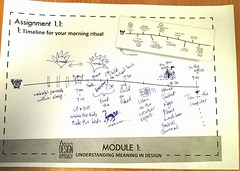
The alarm goes off, throw off the covers, bathroom, brush teeth and shave, warm-up routine, make the bed, make sure the kids are awake and getting ready, get dressed, breakfast, go to work.
Open the office, start the computer, check email, respond, start work tasks. Get a cup of tea and complete more work tasks.
On the physiology of sleep/wake cycles
Our bodies respond to the transition from dark to light, the dawning of the day. No matter what time we go to sleep our bodies respond to the morning. Light stimulates cells in our retinas that in turn stimulating our brain and establish the circadian rhythm. The circadian rhythm is an endogenous cycle of biological activity synchronised with the day/night cycle. The retinohypothamic (RHT) tract is a photic (in relation to light) neural pathway that carries these light=day/dark=night signals to the suprachiasmatic nucleus (SCN) region of the brain. The SCN in turn plays a role in regulating our sleep/awake cycles. As it turns dark outside the RHT signals the SCN which then triggers the pineal gland (PG) to release melatonin, a hormone that prepares us for sleep. Waking up reverses this process. Interestingly the colour composition of the light matters; daylight equivalent is best at triggering melatonin release. In response to the issue of bright LED lighting ruining people's sleep cycles (link) night shift mode on iPhone changes the colour balance of the screen from bright blue/white to a softer yellow/white illumination (link).


References and further reading:
* brainpickings.org by Maria Popova
Joe Hanson's video: Why do we have to sleep, and how did it evolve in the first place? https://youtu.be/3mufsteNrTI via @okaytobesmart
*  Scientific American topic and article "Can Napping Make Us Smarter"
*  Social jet-lag or sleep intertia


Notes on a product for morning rituals

Improve on the LED Pillow Clock or a pillow that lights up?
Why not combine a pillow light with a sleep cycle stage sensor?

Associations
transitions, still tired, restarting
For the purpose of the exercise the morning rituals will be considered to occur over any part or all of the time from waking up to arriving at your next location (work, school). The designer's goal is to have an impact (positive) on the zone of interest, where the design is employed. The impact of the design should be valuable and meaningful for/to its users.

Discussions with others
I found the discussion posts to be really informative, more than just the usual, people are genuinely different, different habits, different rituals, different approaches. So many people do things just plain differently to each other, so much variation in approaches, in what people do, when and where they do it. Different priorities, sequences, orders. Different objects and arrangements.


My morning feelings
My words for feelings, weekend mornings...
Weekday feelings...
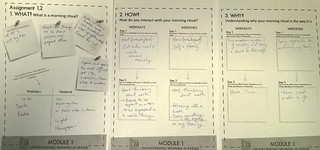
My Morning Ritual - Deconstruction Exercises

Morning Ritual Exercise
The 'what', 'how' and 'why'

WP_20151022_002
The timeline of a morning

Wednesday, July 29, 2015

Tinkering with Technology

Tinkering with Technology: Go to Class -> https://class.coursera.org/tinkering-002
Week One: Introduction to Tinkering
Reflection Question: Having watched the videos what is my reaction?
“What happens when you push the button?” 
Often, the best way to teach, and learn, is to ask interesting questions. If I ask interesting questions I end up challenging myself and/or others to answer them. Often the best questions seem really stupid, or are really stupid, or actually are deliberately stupid, but can be used for a range of things, like stating, re-stating or establishing basic assumptions, like thinking through an idea (often a conclusion) backwards.

I felt, while watching the video, initially sceptical but eventually felt that I recognised the justification for what seem like quite trivial activities. Starting out with the scribble bots, for me at least, is a turn off, but I stuck with it. It took till the unstuffing exercise for me to realise there might be an underlying model, of learning through stages being applied. This happened, a kind of 'ah ha' moment, when I recognised similar mechanics being employed in the design of manufactured toys. I confess to feeling a little concerned when the camera cuts to a child wielding, or rather holding a craft knife while doing something else with his hands. I guess we all learnt something the hard way at some point in time.

Readings Week 1
Excerpts from The Art of Tinkering by Karen Wilkinson and Mike Petrich with contributions from Dale Dougherty, founder of MAKE magazine; Leah Buechley, founder of the MIT Media Lab's High Low Tech Group; and Mike Petrich and Karen Wilkinson from the Exploratorium.

Dougherty offers a nice definition; "Tinkering is the essential art of composing and decomposing physical things to suit a variety of purposes—from practical to whimsical." p6 He describes the necessity, for physical and social interaction to occur, that 'making' is a good and necessary alternative to screen based engagement with things and others.

World-making or world shaping to suit ourselves. The Exploratorium Tinkering Studio presents tinkering as a form of social engagement, like world-hacking perhaps, but I question whether something so individual can ever become a social movement. After all, in spite of the pronouncements to become creators rather than consumers, I feel when I am the bricoleur or tinkerer that I am ultimately doing it for myself, for my own consumption. In making something I'm involved in imagining its use, how it works, how to work it; that's the process of working it out until it just works. It might be rough (like the picture of the toolbox made of tools), seemingly unfinished, perhaps only useful to me and only useable by me. Which suggests to me that bricolage and made things have a long way to go before becoming products for consumption by someone else.

Dougherty then refers to the contributors as artists not designers or product engineers, or milliners or tailors etc. When does the distinction become clear between the maker, hacker, tinkerer and the artist? Is the artist version of a tinkerer a dilatant versus the professional or practitioner (who probably won't be considered an artist?) who is merely technically skilled? Perhaps this suggests rather the individual's development path? A progression from novice to competence to expertise?

Dougherty highlights the necessity of physical and social interaction for making as a good and necessary alternative to screen based engagement with things and others.

Leah Buechley emphasises the feeling of and need for joy and emotional involvement when making, tinkering, doing, breaking down, assembling, building etc. She suggests tinkering is both playful and reflective. The implication for organising for design is that it needs differing temporal pace and changing ambient environment; "quiet and (sometimes slow)" p9.

Counterintuitively it seems that originality finds its inspiration in copying, which begs the question; is anything truly original?

Wilkison and Petrich note that the word "tinker" comes from peripatetic (travelling) tinsmiths of the 1300s, who travelled around fixing stuff. There are suggestions that the word tinker is onomatopoeic in origin, deriving from the noises that a tinsmith's cart or pack made; the wares rattling as they moved through the countryside. In Ireland and Scotland the word is still used colloquially for people of Gypsy or Traveller ethnicity.

Chapter 2 of Invent to Learn, by Sylvia Libow Martinez and Gary S. Stager.

This book links maker, hacker, tinker movements with the academic perspectives on education, design, and cognition.

Although it might not concern many, I worry when writers depict knowledge, thought and learning as a psychological phenomenon "constructed inside the learner’s head" p31. Yes, these things necessarily involve the mind, are phenomena of the mind. However I wish to avoid the implication that such phenomena are 'embrained' processes, reducible to abstraction and rational formulation.

Why is this a concern for me? It's to do with what I believe is an implied model of knowledge and cognitive processes. A 'construction inside the learner's head' implies a kind of realism between a model-structure putatively occurring inside the head, corresponding with external action or perceived phenomena occurring outside or 'in the world'. This type of correspondence theory explaining processes of learning, knowledge etc. taps into the philosophical approach known as critical realism. Critical realism is a cybernetic theory of human cognition and agency, in which the human actor perceives the world and acts according to working hypotheses or models contained within their head. Revisable fidelity of the embrained model corresponding with the 'real world' allows for better decisions (actions) to be made.
A characteristic depiction this problematic approach might be
"the... cybernetic structure is itself enclosed in a meta mental model which might be considered as the world-view of the decider." (Chapter 4: Decision Integrity and Second Order Cybernetics by Anthony Hodgson. in Cybernetics and Systems Theory in Management: Tools, Views, and Advancements by Steven E. Wallis, 2010: p60)
In contrast to the cybernetic embrained view of knowledge, Hubert Dryfuss and others have offered compelling critiques of the cybernetic theory of knowledge, learning and action (e.g. Flyvberg), highlighting the tendency for proponents to resort to meta-theoretical frames and transcendental perspectives, all the while failing to account for how we actually how existence occurs in direct experience. We exist in experience, situated, embodied, experientially involved in being, unable to step out of our being in the world.

The chapter contrasts 'constructivism' with Seymour Papert's notion of 'constructionism'. Constructivism presents psychological development of learning as occurring through processes of actively, mentally, reconstructing knowledge through individual and social involvement. Papert extends this by asserting that...
"learning is most effective when part of an activity the learner experiences as constructing a meaningful product. (Papert, 1986)".
Rather than emphasing embrained processes, effective learning is necessarily embodied and engaged in the world, therefore involvement in constructing and making things builds more authentic learning and knowledge through experience.

Unfortunately emphasising processes as 'inside their head' or 'outside of their head' resuscitates the previous, flawed notion of learning as a cybernetic decision process.

Three useful ways of thinking about learning are presented: making, tinkering and engineering. Making is a kind of goal directed or driven action. Tinkering is a playful attitude or mindset, less driven, more open-ended. And engineering is a kind of analytical process of reflection and objectification, theorising and formalising what is learnt through description, models, diagrams etc. While these three ways of learning may be distinct, they might also be related to each other in terms of process or distinctive periods of learning through doing; Papert's constructionism.

A lot of space is devoted to how we should deal with computers in learning. The authors present a case for the computer to be a raw material for making and tinkering rather than merely an environment for managing action or consuming content.

If we contrast the cybernetic model against these interactive and social processes of tinkering or bricolage (the French world for DIY) we really must conclude that there is more than one way of learning and gaining knowledge, and therefore that we, as learners and teachers, need accommodate "the validity of multiple ways of knowing and thinking." (Turkle & Papert, 1991)

We should also stay open to the risk creating and reinforcing gendered roles and identities with tinkering/making/engineering. Gendered identification and gendered styles of teaching and learning contaminate the language and terminology, the way problems are posed, context setting, space making, power relationships in the learning environment, even seemingly innocuous values like dealing with mess versus tidiness, of risk taking or managing behaviour.

Various key authors are quoted around the topics around play and learning (Piaget, Vygotsky)


Week Two: Initial Explorations with Tinkering
Notes on videos:
Circuit Boards: Seeing It in Action: Illustrates the open exploratory approach, messing around with simple dc circuits. Playful, unstructured. It seems a bit limited but still useful foundational experiential electronics. I particularly liked the homemade feel to the elements, various lights and switches and motors mounted on wooden blocks with connections made with alligator clip wires.
Designing for Tinkerability: Circuit Boards: Activity elements: materials, environment and facilitation. 
Materials are the resources that are used, consumed. This requires a fair bit of thinking-through on the parts of the learning facilitators, thinking through how these resources may be used.
Arrangement of environment deals with resources surrounding the activity like lighting, noise, round tables and chairs on rollers, to be aware of how architecture force upon focusing and defocusing structures. Recognise the value of inspiration by displaying decorations, previous examples, random pictures etc.
Facilitation may or may not as apparent, particularly when groups start self-supporting. Facilitation in this setting is all about encouraging people to be make mistakes and learn from them. To adopt a playful attitude and encourage exploration and experimentation. It might at times be useful to suggest some goal or problem that needs a solution to offer a motivation or challenge. Usually the facilitator is hoping to encourage and support an individual's own curiosity, offering supporting knowledge if needed. , flexible approaches, trial and error, meandering. Strategies for facilitating troubleshooting include suggestions like 'ok, it's looking pretty complicated, is there a way to simplify it? Another approach might be to 'do it again', 'let's repeat'. If something starts working encourage the student to expand it 'ok, now let's extend it or add something to it'. 
Inspiration: Shih Chieh (CJ) Huang CJ is an artist working with lights, motors and found or recycled materials to create curious luminous animated structures. Have a look at CJ's workbench for tips on organising a workspace. And take notice of the parts area, he really puts tupperware to use, he does this work on a scale that demands he be organised and efficient.
Chandelier by Shih Chieh Huang
Making Circuit Boards: Various found materials or components can be 'scrounged' and made into 'circuit board parts'. Things like door bells, lights, switches, fans, led number display, alligator clip connections made to nails soldered to the scrounged part. As the circuit boards and scrounged equipment uses DC battery power ranging up to 12V they are in fact safe enough for anyone to use.
Classroom Connection: Persistence, encouraging the students to persist with solving problems, not giving in to tell them a solution, not telling them how to do it, letting them figure it out for themselves, to watch the kids and see the 'lightbulb moment' going off in their minds. Avoiding telling them what we think they need to know and rather let the students take their own paths and follow their own interests which is healthier.
Pedagogical Perspective: Rob Semper: Refers back to Frank Oppenheimer's (particle physicist and founder of the Exploratorium in San Francisco) contribution, as part of the academic panel, to the ESS the first elementary science study curriculum in the US. Bulbs and Batteries (not ignoring the wires too) to give an understanding of electricity and circuits, which are pretty fundamental aspects of today's world.
CJ Huang TED talk on recent pieces inspired by bioluminescent life forms.
Carol Dweck talking about 'mindsets'; the book MindSet (2006), and the website at mindsetonline.com

Readings Week 2
Circuit Boards Activity Guide: This guide captures all of the material discussed in the previous videos, but includes much more by way of assistance and suggested prompts for facilitators. Practical and well structured, it provides some structure for the earlier recommendations on organising circuit board activities, i.e. materials, environment and facilitation.
Excerpt about Shih Chieh (CJ) Huang from The Art of Tinkering by Karen Wilkinson and Mike Petrich.

Week 2 Reflection Questions
Post photos of some of my circuit boards in the Week Two Activity forum and using the #tinkeringmooc tag.
Q: How has my identity as a tinkerer or my understanding changed?
A: By being braver, being prepared to crack the case and look inside. Sometimes it ends up being pointless, from an investigative point of view, for example, opening up broken Apple power supply, was simply impossible because it was glued and moulded in place, effectively a monolith.
#tinkeringmooc On a positive note, I am now proud to claim that my messy office is actually a "workshop"
Q: Drawings of circuits that worked. Drawings of circuits that didn't work.
A: I was brought back to thinking about why a parallel circuit, with resisters R, has an effective
Parallel Rtot = 1/R1 + 1/R2 + ... + 1/Rn
Whereas a serial circuit has an effective
Serial Rtot = R1 + R2 + ... + Rn
So I thought of an explanation for myself:
Metaphor for parallel: A resister is like a hole through which water (aka electricity, electrical charges) flows, a large hole is like small resistance, a small hole is like large resistance.
So... in parallel, resisters in parallel act like the holes in a sieve or colander. Even though each hole is exactly the same size, the more holes the quicker the water flows through.
Metaphor for series: A resister is like a short incline or ramp that a stream of moving balls (aka electricity, a moving charge) rolls towards and up, losing energy in the process. As the balls progress over a series of ramps they lose more and more energy.
Q: How at ease am I at exploring circuits in this way? How much time did it take? What contributed the "aha" moments, or frustrations?
A: Well soldering is always messy and tricky, the flux sometimes spits, the wires conduct heat and melt other parts, sometimes the insulators burn and make noxious fumes, you always need a second if not third pair of hands to hold everything in place to get the solder where you want it, putting the soldering iron down without burning anything else (especially people) can be delicate.

Week Three: Identifying Dimensions of Learning
Atelier; a word I rarely encounter and never used. However I find it to be evocative and exotic; a studio or workshop, imagined with paint splashes and wood shavings on the floor. A French word, collective noun, describing not just the studio space but includes the master artist, assistants, apprentices, students and others. The word derives from the Old French astelle and in turn from the Latin astula; meaning sticks, fragments, wood chips, splinters.

Readings Week 3
(PetrichEtAl_ItLooksLikeFun_2013)

Petrich et al (2013) show that one of the core experiences of this kind of unstructured designing/learning process is the "process of becoming stuck and then unstuck".
Their interviews of participants also point to "how important the sense of self is in the interplay of objects and activities... it is the personal accomplishment of becoming unstuck, plus having an artifact to point to" pp55-56.

They characterise learning through tinkering in terms of four observable experiential phenomena: engagement, intentionality, innovation and solidarity. These are observable qualities they can identify among the learners involved in the activities they curate.

The design of their tinkering studio incorporates a number of deliberate features; open layout, highly visible workspaces, expansive workspaces (bench tops and tables), an excess of materials, an excess of tools, all types of tools, all resources at hand and readily available.

They developed three interlinked aspects to consider for structuring events within these spaces: activity design, environmental design and design facilitation. Each of these aspects incorporate a number of considerations.

  • activity design
    • Activities and investigations build on learners’ prior interests and knowledge.
    • Materials and phenomena are evocative and invite inquiry.
    • Tools and concepts of science are a means, not an end.
    • Multiple pathways are readily available.
    • Activities and investigations encourage learns to complexify their tinkering over time.
  • environmental design
    • Past project examples and current activities are situated to seek ideas and inspiration.
    • Activity station design enables cross-talk and invites collaboration.
    • Studio layout supports individual initiative and autonomy.
    • Activity adjacencies encourage the cross-pollination of ideas.
  • design facilitation
    • The facilitation is welcoming and intended to spark interest.
    • Facilitators try to focus learners' attention, based on individual paths of understanding.
    • Facilitation should strengthen understanding by helping learners clarify their intentions through reflective conversation.
Origins: Design Principles - Structure (Petrich et al, 2013: pp58-65

They also suggest empirical observable "tentative indicators of learning" along the four experiential phenomena mentioned earlier, Moreover, participation is characterised by these indicators being evident continuously through being "engaged in the flow of tinkering activities".

  1. Engagement 
    • Duration of participation 
    • Frequency of participation 
    • Work inspired by prior examples 
    • Expressions of joy, wonder, frustration, curiosity 
  2. Intentionality 
    • Variation of efforts, paths, work 
    • Personalization of projects or products 
    • Evidence of self-direction 
  3. Innovation 
    • Evidence of repurposing ideas/tools 
    • Evidence of redirecting efforts 
    • Efficiences gained through growing fluencies with concepts, tools, and phenomena
    • Complexification of processes and products 
  4. Solidarity 
    • Borrowing and adapting ideas, tools, approaches 
    • Sharing tools and strategies; helping others to achieve their goals 
    • Contributing to the work of others
Indicators of Learning (Petrich et al, 2013: p66)
The concept of scientific and engineering practices is powerful because of its inherent conception of learning as processes of being, doing, knowing, and becoming. (Petrich et al, 2013: p67)
Week 3 Hangout on Google+
Journals - Make Journaling a Habit!
I liked the discussion on Tinkering Journals (at 16').
Tinkering journals belong to the same genre as Science Journalling and note-booking.
Consider the different styles and formats possible for journaling, examples like...
Accordion books
Process books.
Process brainstorms on a roll of paper by turn taking speaking and capturing (ref Todd Elkin).
A technique called the thinking routine from Project Zero to achieve the reflective mindset: "I used to think... But now I think..."

#tinkeringmooc

When a learner asks "why?" Often the last thing they want or need is for the answer to be given to them. What we as teachers should enable, is not to provide answers to questions, but to facilitate learning through personal discovery. So when someone asks "why?", a good answer might be "I don't know, but I think I might know how to start the process of finding an answer".

In order to put some shape on this as a process consider the following "moves":
  • Diagnose: Identify the problems(s)
  • Discover: Independently research the problem area(s)
  • Develop: Propose a response or responses, recommendations to resolve, improve etc.
Week 3 Sketchbot
Photo-journal: steps to make a Sketchbot
Readings Week 4
Perhaps the best place to start is to be inspired by someone else's work and try to adapt or emulate them. Rather like, as Steve Jobs said (attributing Picasso with the original quote, although the expression's history is complicated
"expose yourself to the best things that humans have done, and then try to bring those things in to what you're doing... good artists copy, great artists steal..." (ref YouTube link)
Creative confidence is (for me) a kind of throwing myself into a situation with some kind of idea of what I want to do out of focus and not-quite-formed floating around the back of my head.

How about this for another Tinkering Tenet; "Make it Same Same but Different" #tinkeringmooc @TinkeringStudio

I was asked my opinion on the top emerging high-tech trends and developments that will impact business and society over the next decade. And everything I pointed to lends itself to a Tinkering attitude...
1. User experience / user interaction design teams will grow. Firms will invest in setting these teams up themselves.
2. Growth of tinkering / hacking movement using new digital platforms such as Raspberry Pi, Arduino and wearable computational devices such as LilyPad.
3. Growth of IOT (internet of things) tech and services permeating everyday life.
I think there is a need for a part A and part B "design experience" module that deals with these topics. The teaching and learning environments for this should focus on tactile-embodied-learning-with-objects, workshops and hands-on sessions that engage students with technology. For example, commercial website hosting services, content management systems, and new computing paradigms like Raspberry Pi, Arduino and IOT devices.
 
Week 4 Circuits. Paper circuits and sewn circuits.
Well I don't have copper tape, so I'll use kitchen foil, it conducts electricity ok but can I solder it?
And I don't have conductive thread, so I'll just use thin insulated wire, that should do the trick.
I'll scavenge some LEDs from broken electronics and perhaps even scrounge some surface mount LEDs.

Well partial success. The LEDs I ended up with needed resistors and a 6V supply, which made them a bit too bulky for the paper circuit exercise so we adapted the situation and made a spooky Halloween mask a little bit spookier...
Added some LED eyes and warts to a Halloween decoration.
Week 5
The Tinkering Studio highlight a quote by Charles Eames "Toys are not really as innocent as they look. Toys and games are preludes to serious ideas." Toys and games are complex but when you open them up, they are ultimately knowable and adaptable.
The Thinking Routine approach (parts + purposes + complexities) developed by Agency by Design, part of Harvard's "Project Zero" (http://www.pz.harvard.edu). Also see https://makingthinkinghappen.wordpress.com/ which moved its activity to http://www.agencybydesign.org/
This is treated as a structure through which personal learning goals and outcomes emerge from the exercise.

Jay Silver's and Eric Rosenbaum's reflections about making, about Makey Makey, are both quietly inspirational.

An insightful phrase appears in Mitchel Resnick's essay: the idea of "hard fun"(I am inclined to include "hard play"). This is a counter narrative to the sugar coating of difficult tasks by the "edutainment" approach and the un-fun-ness of playing hard in zero sum games.
Another interesting idea is the "design cycle can be seen as a type of play".
Both ideas come together through "playful learning (and learningful play)".

Overall reflection
I like that the lecturers have designed the course with evidence and justifying arguments in mind. This is a useful introduction to the literature on learning, with a clear lean towards activity theory and potentially the philosophy of phenomenology. While the literature they draw on tends towards early childhood development, I think it should be possible to extend this towards adult learning, to educational philosophy of designing in general.
I'm a great believer in journaling and was inspired by some of the examples presented for establishing self-journaling practices in the participants. For example, using the large sheets of paper to organise the Toy Take Apart activity, assigning process/practice meaning to the diagrams by the simple device of changing the colour of the marker for the different stages.

Tentatively might terms such as 'generative activity' and 'generative design' suggest a more general theory, orientation or approach to interpreting lightly structured activity based learning such as occurs in tinkering workshops and similar open-ended learning, stroke, creative environments?

Structure of the Final assignment (not submitted)
Part 1. Initial Goals and Expectations (10 points)
Part 2. Tinkering Journal (30 points)
Part 3. Tinkering Action Plan (20 points) including a SOMEDAY Action Plan and a MONDAY Action Plan.

Wednesday, January 21, 2015

R and Harvard's PH525.1x MOOC

Having enrolled "Statistics and R for the Life Sciences" run on EdX by Harvard (MOOC module PH525.1x)...
Some notes and pointers for R; introductory and tutorials for basic statistical treatment of quantitative data.
As an aside comment, would you believe that running R commands and generating plots, makes data fun and surprising? Or is it just me? At least it's something different, perhaps more interactive than doing the same thing in a spreadsheet. Did I say it felt like fun already? Perhaps when generating those beautiful little graphs automatically?

Definitions: p-value, confidence interval, random variables, null distributions, central limit theorem, inference tests like t-test, association test, permutation test.

Getting started with R. The software first.
Download and install R from CRAN http://cran.r-project.org/
Download and install R Studio for the desktop (the same people also run/operate Shiny) http://www.rstudio.com/products/rstudio/download/ 

Q: Am I on the latest version of R?
Check you're on the latest version, if not download the latest package (on MacOS use Safari).
Run md5 checker from the terminal and verify.
md5 R-3.2.2.pkg MD5 (R-3.2.2.pkg) = dd8999f50c5d4e392832797d091642db
Then check the installation works, run R.app, type version at the R console to verify the expected installed version is running.

Q: Same: am I on the latest version of R?
Check you're on the latest version, if not download the latest package (on MacOS use Safari).
md5 RStudio-0.99.489.dmg MD5 (RStudio-0.99.489.dmg) = 05cf866b07df6552583f98314ed09d38
Again, check the installation works, run RStudio and go to RStudio>About RStudio to see the version window.

Links for learning.
Pointers to external material (from the EdX course)
The underlying concepts.
  • Vectors (single or multi-element row, single data type)
  • Matrix (multi-element array, single data type)
  • Lists (a vector of mixed data types, organised into named components $xxx)
  • Data Frames (an array-like form of R list,  a matrix of mixed data types in which each column of the matrix corresponds to a vector. Can be addressed different ways, by named component or index location)
Matrix commands
> m <- rbind(c(1,4),c(2,2))  # rbind( ) is a function for row bind. cbind( ) is the corresponding function for column bind.
> m
    [,1] [,2]
[1,]   1    4
[2,]   2    2
> m %*% c(1,1)  # matrix multiplication operator
    [,1] 
[1,]   5
[2,]   4
> m[1,2] # return value at matrix index location 1,2
[1] 4
> m[2,2] # return value at matrix index location 2,2
[1] 2
> m[1,] # row 1, shows how to extract submatrices from a matrix
[1] 1  4
> m[,2] # column 2, shows how to extract submatrices from a matrix
[1] 4  2

A series of setup steps in R/RStudio (and using stuff at https://github.com/genomicsclass/dagdata):
> install.packages("devtools")
> library(devtools)
> install_github("genomicsclass/dagdata")
> install_github("ririzarr/rafalib")
> 1:10
    [1]  1  2  3  4  5  6  7  8  9 10
> x <- 1:10
> y <- rnorm(10)
> plot(x,y)
> ? read.csv
> dat <- read.csv("femaleMiceWeights.csv")
You might need to set the working directory to get read.csv to find the right file


> class(dat)
> head(dat)
> dim(dat)
> dat$order
> colnames(dat)
> dat$sleep_total
> c(dat$sleep_total, 1000)
> plot(dat$brainwt, dat$sleep_total)
> plot(dat$brainwt, dat$sleep_total, log="x")
> summary(dat)
> dat[c(1,2),]
> dat[ dat$sleep_total > 18, ]
> dat$sleep_total[ c(1,2)]
> dat[dat$sleep_total > 18,6]
> mean(dat[ dat$sleep_total > 18,6 ])
> dat <- read.csv("msleep_ggplot2.csv")
> which(dat$sleep_total>18)
> dat$sleep_total[which(dat$sleep_total>18)]
> dat$sleep_total[22]
> which(dat$sleep_rem<3)
> which(dat$sleep_rem<3 & dat$sleep_total>18)
> sort(dat$sleep_total)
> order(dat$sleep_total)
> dat$sleep_total[order(dat$sleep_total)]
> rank(dat$sleep_total)
> rank(c(1,2,2,3))
> match(c("Cow", "Owl monkey", "Cheetah"), dat$name)
> idx=match(c("Cow", "Owl monkey", "Cheetah"), dat$name)
> dat[idx]

Q: Running a simple correlation analysis in R
Useful videos (link) (link2)
The presence and strength of a linear relationship or correlation between two quantitative variables can be tested by calculating the correlation coefficient (r) between the two variables.

> argentina<-read.csv('countries.csv')
> head(countries)
    country year gsli.total gsli.financial gsli.people u5_mortality_rate life_expectancy unemployment_rate
1 Argentina 2004       5.07           3.25        0.74                       17.9                       74.5   12.2
2 Argentina 2005       5.05           3.14        0.93                       17.1                       75.0   10.6
etc.

Run a correlation test between the two variables (vectors) we want to compare, i.e. countries$gsli.total and countries$unemployment_rate.

Q: Making a pairs plot to highlight possible correlations between multiple variables
Produce all possible pair-wise plots (link)
> names(countries)
[1] "country"                    "year"                    
[3] "gsli.total"                 "gsli.financial"          
[5] "gsli.people"                "u5mr_mortality_rate_median"
[7] "life_expectancy_from_birth" "GET_UR"                  
> pairs(countries[,3:8])
pairs-plot for the countries dataset (for axes read x-y as illustrated gsli.total v gsli-fin)
By inspection the only variable without obvious possible correlation is gsli.total.


Tuesday, November 18, 2014

Raspberry Pi: imaging the SD card on a Mac

Get started with RaspberryPi.org (link) or with Raspberry Pi on e14's website (link).
Most recently used "NOOBS Offline and network install".

So starting with the SD card inserted and mounted... in MY CASE ONLY, from an xterm using the df -h command, the device name (and therefore the 'raw device name') is disk1 (or rdisk1 or rdisk2 for its raw equivalent), I did the following...

1.

Check which device maps to the SD card. This is the high risk bit because you may end up formatting the computer hard drive, never a good thing to do unintended!
Check
$ df -h
Filesystem      Size   Used  Avail Capacity  iused  ifree %iused  Mounted on
/dev/disk0s2   112Gi  108Gi  3.6Gi    97% 28456655 955713   97%   /
devfs          184Ki  184Ki    0Bi   100%      636      0  100%   /dev
map -hosts       0Bi    0Bi    0Bi   100%        0      0  100%   /net
map auto_home    0Bi    0Bi    0Bi   100%        0      0  100%   /home
map -fstab       0Bi    0Bi    0Bi   100%        0      0  100%   /Network/Servers
/dev/disk1s1   3.7Gi  832Ki  3.7Gi     1%        0      0  100%   /Volumes/XBMC
Check again
Write it down.
And check again. For example run ls on the disk path to verify you can and that you access and list the SD card.

2.
Next, unmount it using 'sudo diskutil unmount /dev/disk1s1' (my case only). The icon will also disappear from the desktop confirming this step was successful.
$ sudo diskutil unmount /dev/disk1s1

3.

The last step is to write the image file to the raw SD card device as identified above, replacing disk1s1 with rdisk1:
$ sudo dd bs=1m if=./raspbmc-2013-12-23.img of=/dev/rdisk1
After anywhere from 3 to 5 minutes the disk image write finishes. The xterm looked like this:
1300+0 records in
1300+0 records out
1363148800 bytes transferred in 243.253827 secs (5603812 bytes/sec)
And there's a shiny new disk labelled 'Untitled' on the desktop. At first impression it looks like your 4G or 8G sized disk has tragically shrunk to 60 or 70 MB. The reason is that the SD disk has or will have a Linux swap partition and a Linux filesystem partition occupying the available space. The good news is that most of the slack space can be recovered the first time you load this SD card on the Raspberry Pi via one of the Pi configurator (raspi-config) options to reallocate the space from the linux partition to the FAT32 partitio

Wednesday, March 19, 2014

Teaching with blogs: A provocation in the age of MOOCs

Q: What do I mean  by 'teaching with blogs'?
I use public blogs as online resources used in parallel with in-class interactions and a course area within the University's Blackboard area.

Q: Why bother? Isn't it twice the work to run two separate web sites for your course?
I have felt drawn to establish at least part of my teaching structures outside of Blackboard and the various firewalls or paywalls that surround the University's online environment, for a number of reasons...
  1. I asked myself, how many 'clicks' did I have to make use of one of the official tools for online collaboration, in my case Blackboard's collaboration features: blogs, wikis, forums, class groups? 
  2. I have found that spontaneous student engagement with online collaboration behind the Blackboard firewall is minimal (I'll use the term firewalled even though technically speaking they are more likely to be just under login control).
  3. Is the material I teach proprietary, top-secret, controversial? No, nearly everything is in the public domain.
  4. Is student identity something I need to control? Well the people I teach are adults undergoing professional career development in high tech industries employing networked internet technologies as basic infrastructure. Online professional communities inform their professional and academic formation and development.
  5. And while I've been agonising about non-engagement with the official collaboration tools, students themselves have already made the shift. The have readily moved outside of my and the University's control, forming their own FaceBook or LinkedIn groups, their own Twitter followings and hashtags, shared areas and shared documents with Google Docs or DropBox, their own persistent group conversations and communications in Skype, Messenger, iMessage etc.

The distinction between a Blogger website and Blackboard is simply:

  • Blackboard: Private - login restricted.
  • Blogger: Public - open, freely available anywhere.

Both have their uses.
The University's login restricted resources give me a secure login restricted area for files: readings, student reports (submitted using SafeAssign), and my slides (although I'm increasingly using Slideshare if the material conforms with copyright.
Blackboard is also useful for communicating, as a class email device using student's official University email addresses.
The blog confers a sense of transparency; it is public, it is freely available to anyone in the world, it does evolve visibly and publicly over time.

Reflecting on this arrangement I note a shift in emphasis in the wider educational technology scene, from institutional obscure resources held privately, towards open transparent resources presented in public. The shift in emphasis is not wholly in one direction, it is balanced as noted above. Login restricted resources still have their uses, public presentation has its. Furthermore, fixating on the location of online resources as behind or outside of restricted logins neglects another crucial dimension, the classroom. What happens in the classroom? More on that later.

Where do Massively Open Online Courses (MOOCs) fit into this? MOOCs look at lot like Blackboard. Some are open, public, accessible. Some are University-style with fee elements and business models. Some are fully commercial training, servicing buzz areas like Big Data, SAP training, etc. There is a spectrum of for-fee and free/open offerings. Like any technology infrastructure some MOOC frameworks are easier than others. Indeed even within the same technology/platform/framework they may be configured and deployed in more or less effective manners.

From the student's perspective MOOCs differ wildly. The experience of learning through a MOOC can range from intensive to light. I found that Coursera's "Calculus One" course, delivered by the Ohio State University, demanded considerable time and attention just to process the weekly lectures. "Calculus One" required the same full time commitment that a regular University course in calculus requires. On the other hand, Courseara's "Gamification" course, designed by Kevin Werbach from the University of Pennsylvania seemed tailored for part-time or executive style of engagement by people in work perhaps or motivated by curiosity to study the material. Similarly the Udacity course "Intro to the Design of Everyday Things" facilitates a casual style of learning engagement but importantly, an experience centred by the involvement of the outstanding author of the field, Don Norman, who personally presents the course.

Reflecting on the MOOCs that I have participated in and comparing them with the courses I teach myself I am drawn back to the question of that 'other question'; what happens in the classroom? And why do I feel so comfortable with putting nearly all of my teaching materials and structure on a public blog?

MOOCs, like I suspect any kind of learning process that becomes nearly wholly mediated by disembodying technologies and objects (think Blackboard, blogs, even books), result in mixed outcomes in terms of completion, student engagement, and accomplishment upon completion. They offer very weak social-relational opportunities and they depend on highly motivated, self-organised, well-organised students to succeed and there are some aspects of experiential learning in classes and in groups that simply do not translate well into the virtual setting of these online tools.

A 'provocation' is in the title of this post. Why? Come back to the idea of 'teaching with blogs'. It could be in Wordpress, Blogger, FaceBook or something else. What is the essence of these things and why might it be a provocation to higher education? The following illustrates the provocation:

Open <<>> Public
Closed <<>> Private
What happens in the classroom?
For me the utility of MOOCs or any kind of online learning resources (Articulate, Blackboard, blogs, etc) is in how they either highlight (or neglect) real engagement by the participants and that brings me back to the classroom, the temporal and physical collocation of learners with each other and with expert practitioners. The utility of these tools and resources is in how they afford the opportunity for different kinds of learner engagement. Learner engagement can be refocused, instead of acquiring rote facts, consuming slides or presentations from lecturers the lecturer can choose to turn the classroom around, to spend time instead on discussions, exercises and projects.

Implications?
After decades of hype and speculation about the potential for digital and online technology in higher education, some would say that the future has arrived. However, for me, MOOCs and blogs are more a provocation to return attention to the practice of learning and teaching. The first thing I do is to urge students to break out of their safe zones. Hosting a classes involves a fine balancing act between exploring unknown territory and moving through the content I expected to be covered. Slides are very good at producing the latter result; projects, interactive exercises and discussions are very good at doing the former. Studies of learning suggest that people pass through many stages of skill and competency regardless of whether in technical or intellectual prowess. Dreyfus & Dreyfus (1986) describe five steps from novice to expert:
  1. Novice
  2. Advanced beginner  _______________|
  3. Competent performer                             |
  4. Proficient performer
  5. Expert
Novice and advanced beginner learn in protected situations, with the support of rules and procedural style ways of performing. Competence, proficiency and expertise however require experience in order to develop. To get beyond procedural and rule oriented action towards expertise demands learning experiences in actual situations with fewer supports. Attaining expertise and effective intuitive engagement in problematic situations requires experience in increasingly un-protected environments.

John Seely Brown and Paul Duguid's (1999) analysis of the promises and rhetoric of the information age highlight for me the limits of information technology and the conventional misunderstandings surrounding learning. Understanding the essences of learning, I think, helps us respond in meaningful and measured ways to the pressures on higher education. University degrees are no longer optional, they are seen now almost as a prerequisite for entry to the workforce. Having an undergraduate degree or even a Masters is now 'the new normal'. There is pressure from the student body for learning and degrees that add value to them as citizens in society and the workforce. Universities are thinking like businesses (for better or worse), scale and reputation matter. University fees are increasing but many perceive that there are fewer supports available for learning and teaching. For profit and not-for-profit are encroaching on each other and new technologies provoke us to rethink what and how we do higher education. 

(presentation link)

References:

  • Dreyfus, H. L., Dreyfus, S. E. & Anthanasiou, T. (2000) Mind Over Machine: The Power of Human Intuition and Expertise in the Era of the Computer, Free Press.
  • Brown, J. S. & Duguid, P. (2000) The Social Life of Information, Harvard University Press.

Interviews with users - Comments on MOOC style education

Interview A - University Lecturer
"I kind of stumbled on the course, I've registered in the past to Coursera, EdX and others so I get their emails but usually delete them, particularly Udemy, they're into hard selling"
"Coursera, EdX, Udacity come across as more academic because you can do them for free"
"I signed up on this one because the course subject matter was relevant to what I was currently researching"
"I'd never heard of the lecturer before but he has written a short book"
"The course is based on his book, I bought a copy, read it quickly, it really repeats what the video lectures cover"
"Having the book is good"
"I have also sought out some of the other references that the lecturer uses, they have generally been much more important and useful"
"I started the course a week or two late so I was already getting penalties for the first few quizzes"
"I'm not sure if I'll get a good grade, but that's not why I'm doing the course"
"The quizzes are good for some basic feedback, you can take them up to 5 times and learn where you went wrong"
"For me, if I make a mistake in the quiz it's because I mis-read the question or didn't read the question carefully enough"
"I often read things out of sequence or skip ahead, when I go back I can see what I missed, some detail, or mis read"
"I like the essays, this course has three or four, they're a good opportunity to put the learning in your own words"
"I'm not sure whether this style of learning is for everyone, the forums aren't really my thing, I haven't got the time to 'socialise' or engage in that way"
"I'm kind of squeezing this course around my work /family life, I don't think anyone knows I'm doing it, well I haven't advertised the fact, but I've had to work through to midnight a couple of times to keep on top of the learning videos"
"Each video runs for around 10 minutes which is good, you can take in slices during the day"
"I'd spend as much time making notes and reflections as watching/listening to the videos, possibly more, three of four times as much if I'm trying to make it meaningful and put it in my own words"
"This lecturer has little question breaks or exercises in most of his videos, I like that because it's an opportunity to reinforce a point and test my understanding"
"We were told that over 70,000 students registered and that 42,000 students have watched video lectures by the half-way point"
"The lecturer is quite playful, he introduces random visual elements in the background of his office bookshelf in each lecture"
"I can see myself using similar tools to lecture a class, but I'm not sure I could push it all online"
"If I developed online material like Coursera courses then I'd probably shift class time to being more practically oriented, addressing skills or interactional aspects that need real-time engagement that don't translate well to digital mediation"
"The economics of this kind of delivery seem puzzling, if a lecturer has written a book then the MOOC would drive demand for sales but the University wouldn't get anything"
"If a course certificate is bought I suppose the University and Coursera could share the revenue, that could offset the hosting costs, two or three teaching assistants, equipment, rack space, disks, bandwidth, hosting the service"
"The production qualities have to be very good, the forums need (and get) close moderation, the systems have to be tested and bulletproof, an issue with a reference essay for peer assessment came up with my course, so a whole administrative, review, communications exercise had to start up to respond"
"I expect there is a very well run professional education/media team working with the lecturer in his home University, I also expect the University media/education team also works closely with Coursera's staff with operational involvement, reporting etc"
"I was happy with the way the peer grading has worked so far, also somewhat amazed that I've stayed on top of the essays, probably because the parameters are quite narrow and relatively easy to attain, however I have felt satisfied with the result and definitely taken my own contributions seriously"
"I wouldn't consider doing this kind of MOOC teaching unless I was 100% committed personally and 100% supported by my own University"
Interview C - University Lecturer
"I signed up because the course was delivered by a Nobel Prize winning lecturer"
"The lecturer videos are about 2 years old but the lecturer has updated each lecture with a short preface video"
"The lectures are in video format, about 40 minutes long"
"The MCQs are relatively easy, and this week we have an essay"
"I plan to do the essay, it's peer marked so I'll also have to grade some"
"I missed the start date by a week so had a late completion penalty on my MCQ score, I'm not sure if I can make it up over the course to get over 70%"
"This course has two teaching assistants and you can email questions to the lecturer but with 10,000 students..."
"I have a question, I hope it gets added to the list but it might not, he might not be able to respond"
"I might get in touch with him directly, I'm sure I can just email him and ask my question"
"No, I can't see why a general audience would be interested, not unless I was famous"
"From a lecturer's standpoint, why would you do it? Well I think it works well if you've published a book"
"I would do it if I had published a book, I can see the benefit, I have two or three of this lecturer's books and plan to buy the latest one"
"I like the videos, I've gone back to the lecture and replayed an important section"
"I have even used some of the ideas for my own lectures, in fact the lesson I taught last week had a part based around part of the content that I was covering myself in the MOOC"
"I can see why the University might go for it, this course I'm doing has more than 10,000 students enrolled on it, of that perhaps 1,000 might get over 70% and want to pay for the $50 certificate, so it makes sense"
"I'm not sure if I'd buy the certificate myself, what would I do with it? Stick it on the wall? No one can stop me saying I did the course, I can put it on my C.V. if I want"
"If I had to I would consider developing my own course using MOOC tools, but only if it was a policy we had agreed"
"I'd be worried that we're doing ourselves out of our jobs"
"I think it (MOOCs) will be very disruptive, looking to the US where college fees are so high, many people will choose the MOOC version because they simply cannot afford the University alternative"
"Here in Europe where the fees are much lower, they're affordable really, I can see that things will change more slowly"
"But if I was a PhD starting out today in an academic career I'd be very worried"
"Once you've recorded your course there's nothing to stop it being delivered again and again, perhaps without you"
"On the other hand, it might free up more time for research, if the teaching load is lessened with video lectures, we should be given more time for research, that's the optimistic view"
"As for the MOOC I'm taking at the moment, I'm really happy with my scores so far so I think I'll complete it, I might even purchase the completion certificate"
"If the same course was being offered in a University locally by a local academic, well, I think I'd prefer the MOOC, it is delivered by the leading expert, no debate, that's why I'm taking it, so no I wouldn't be interested in the local alternative"
"How should a peer review another's work?"

-----------Instructions for Peer Review of Work---------
Review criteria 

In grading the assignment of your peers, please be kind and considerate.

Please provide constructive and descriptive feedback that will motivate the assessed person to improvement. Always critique fellow students as you would like to be critiqued yourself!

You assignment will be graded on how well you do the following:

(A) Specificity: Did the learner answer the questions directly? Were the recommendations actionable? For example, listing one strong and one weak element of a country’s pandemic preparedness plan.

(B) Clarity of argument: Were the answers clearly formulated, with conclusions rising logically from preceding arguments? 

(C) Use of learned material: Did the answers include specific concepts and insights covered in the materials of this module?

Use of evidence: Was evidence provided to support the arguments? Were the sources provided reliable?

-----------Instructions for Peer Review of Work---------
Review criteria 

In grading the assignment of your peers, please be kind and considerate.

Please provide constructive and descriptive feedback that will motivate the assessed person to improvement. Always critique fellow students as you would like to be critiqued yourself!

You assignment will be graded on how well you do the following:

(1) Pick a policy area and identifies a specific community whose views you believe should be included in policy response, but whose voices have not yet been heard/included or have not been addressed properly.

(2) Explain why you believe the policy response is not adequate for this group..

(3) Propose a brief participatory approach to incorporate this community’s views into the policy.

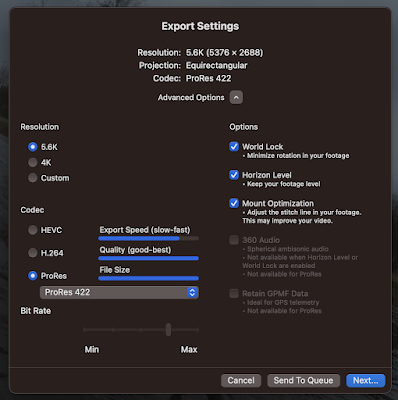
Sharing 360° video?

So, you've got a 360 degree video file from your GoPro. What to do with it? Well, share it on YouTube. YouTube supports uploading and pl...