 |
| From Scrapbook Photos |
Wednesday, February 22, 2012
Exercise: VLOOKUP - what it is, what it's good for, how to use it
What is VLOOKUP? A function that performs 'vertical lookups' in a spreadsheet.
VLOOKUP and HLOOKUP allow spreadsheets simulate the functionality of relational databases. LOOKUP functions employ database-like functionality and concepts like array indexing (column or row) over a number of tables.
The syntax is generally as follows:
lookup_value (the value you want to find in the table or array)
array or table_array (the range of cells comprising the table you are using e.g. $A$1:$C$9)
row_index_num or col_index_num (the content of the corresponding array location as indexed from the array you defined earlier, e.g. col_index_num value of '2' will return the value from the 2nd column)
The following illustrates - an example in Excel for Mac.

Goal
The objective of this exercise is:
to introduce the vlookup function;
Secondary goal is to use basic spreadsheet calculations: sum, addition, multiplication, bracket rules, cell ranges, relative cell references, absolute cell references.
Materials
At least one laptop computer running Excel or another spreadsheet application in each group.
Instructions
Allocate 20" to complete exercise.
Groups of between 2 to 3 students working on a single laptop.
Open the exercise spreadsheet and enter formulae, values and calculations to answer the set questions.
Comments
What to do if the student is running a Mac without MS Excel installed? Use Google docs spreadsheet in that case.
1. login to Google, select Docs and click the 'create new' button (LHS).
You can use the following example on googledocs.
VLOOKUP and HLOOKUP allow spreadsheets simulate the functionality of relational databases. LOOKUP functions employ database-like functionality and concepts like array indexing (column or row) over a number of tables.
The syntax is generally as follows:
lookup_value (the value you want to find in the table or array)
array or table_array (the range of cells comprising the table you are using e.g. $A$1:$C$9)
row_index_num or col_index_num (the content of the corresponding array location as indexed from the array you defined earlier, e.g. col_index_num value of '2' will return the value from the 2nd column)
The following illustrates - an example in Excel for Mac.
Goal
The objective of this exercise is:
to introduce the vlookup function;
Secondary goal is to use basic spreadsheet calculations: sum, addition, multiplication, bracket rules, cell ranges, relative cell references, absolute cell references.
Materials
At least one laptop computer running Excel or another spreadsheet application in each group.
Instructions
Allocate 20" to complete exercise.
Groups of between 2 to 3 students working on a single laptop.
Open the exercise spreadsheet and enter formulae, values and calculations to answer the set questions.
Comments
What to do if the student is running a Mac without MS Excel installed? Use Google docs spreadsheet in that case.
1. login to Google, select Docs and click the 'create new' button (LHS).
You can use the following example on googledocs.

Monday, February 20, 2012
Exercise: Pivot Tables
The following figures illustrate answers for assignment 5.
Note: Present each report in a separate, new worksheet.
Starting the pivot with the example spreadsheet:

a). Create a pivot table displaying a breakdown of the sales for each month in each state.
(i). In an attempt to identify trends, group the Month field by Quarters only.
(ii). Now adjust the Pivot Table so that it shows the sales in each quarter as a percentage of the full year.

b). Create a new pivot table displaying the type of product that was sold in each state for each month. Arrange the fields in a manner that most easily displays the information.

c). Create a PivotTable Report showing breakdown of the sales for each month in each state with pages formatted by Type.
(i). Filter the Type to show just White products.
(ii). Identify the state that does not have a good sales record. Filter this data to show what total sales would look like without this State.

d). Create a Pivot Chart displaying the sales per state for each month. Allow this chart to be filtered by product group.

Note: Present each report in a separate, new worksheet.
Starting the pivot with the example spreadsheet:
a). Create a pivot table displaying a breakdown of the sales for each month in each state.
(i). In an attempt to identify trends, group the Month field by Quarters only.
(ii). Now adjust the Pivot Table so that it shows the sales in each quarter as a percentage of the full year.
b). Create a new pivot table displaying the type of product that was sold in each state for each month. Arrange the fields in a manner that most easily displays the information.
c). Create a PivotTable Report showing breakdown of the sales for each month in each state with pages formatted by Type.
(i). Filter the Type to show just White products.
(ii). Identify the state that does not have a good sales record. Filter this data to show what total sales would look like without this State.
d). Create a Pivot Chart displaying the sales per state for each month. Allow this chart to be filtered by product group.
Wednesday, February 15, 2012
Discuss: Senior Management Knows It All
The motion for discussion is...
"Senior Management knows it all! discuss"
Goal
To critically assess Nonaka's claim that innovative knowledge-creating corporations can be modelled as 'organisms,' with Senior Management envisioning, Managers interpreting and Employees experiencing.
Instructions
Two groups (red-against, blue-for) will present an analysis and then debate the merits of their different positions, involving the whole class in the closing stages.
The readings given for initial investigation are listed below. We strongly encourage the use of additional secondary sources and providing examples as evidence supporting arguments.
Readings
NONAKA, I. & TAKEUCHI, H. (1991) The knowledge-creating company : how Japanese companies create the dynamics of innovation, New York ; Oxford, Oxford University Press.
Tuesday, February 14, 2012
Open source programs open to scrutiny
It gives me a sense of comfort to know that open source programs are open to scrutiny by people who just want to know stuff and to people who need to know and be able to critique it. In this example Tali Garsiel, a developer in Israel who likes to figure out how things work, began exploring the internals of Firefox, Chrome and Safari (which is partly open source). She documented what she found... (link)
Dutch aim to explicitly protect "Fair Use"
What does the Dutch stance on relaxed copyright protections mean for Europe as a whole? A relaxed position on copyright or a lazy one? (link)
Thursday, February 9, 2012
Ireland’s clouds a computing advantage?
(25.09.2009) Microsoft's completion and commissioning of a major European data centre in Dublin West to service the growing use of cloud computing services and applications was announced in 2009. Dublin was well placed to be selected to be one of Microsoft's key hubs for these growing services due to geographical and environmental factors, in addition to Ireland's previously acknowledged advantages for basing high technology industries here (education, language, cultural aspects, access to Europe, clustering of other high tech industries).
It is interesting to note that Ireland's climatic conditions are now seen to offer specific advantages for the operation of computer server farms - large, conditioned, secure facilities housing thousands of rack mounted computer servers - due to Ireland's relatively low ambient temperatures. Annual temperature averages for Ireland hover around 9°C, with coastal areas experiencing a relatively smaller range around the average than inland areas due to stablising influence of the Atlantic Ocean and the Irish Sea. Coupled with Ireland's stable temperature profile, its relatively high average annual rainfall raises the efficiency of geothermal heat pumps, which in combination help to minimise one of the principle cost drivers for data centres, the cost of cooling computers.
For more see SiliconRepublic.com
Subscribe to:
Posts (Atom)
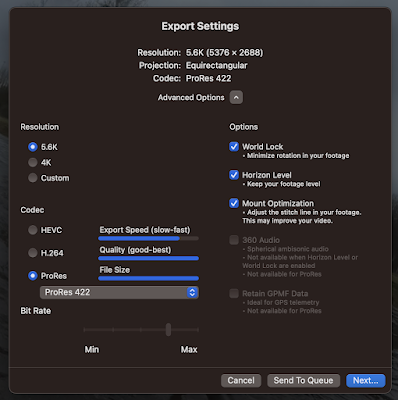
Sharing 360° video?
So, you've got a 360 degree video file from your GoPro. What to do with it? Well, share it on YouTube. YouTube supports uploading and pl...
-
 So, you've got a 360 degree video file from your GoPro. What to do with it? Well, share it on YouTube. YouTube supports uploading and pl...
-
(CTAN, a meta-level resource for all things TeX www.ctan.org/ ) Step 1: MacTeX packages for Mac. Install MacTeX, after which do the foll...
-
First, read the article "AI-generated art illustrates another problem with technology" by John Naughton on the Guardian (20 Aug...