Citizens:
Every citizen with a home address
Business & Organisations
Every business, organisation and department with an address in Ireland. Every organisation that stores customer or member address data would be impacted by the postcode system.
An Post:
The national post service.
3PL Industry:
Transportation, freight forwarders, parcel services, and third party logistics providers (3PL)
Hybrid e-tailor/fulfilment enterprises
Specialist warehousing, pick and pack, robotic distribution centres
ComReg/ODTR
Established in 1999 the Commission for Communications Regulation (ComReg) operated from 1999 to 2002 run by a single commissioner. The Commission was replaced by the Office of the Director of Telecommunications Regulator (ODTR) in 2003 and the governance structure altered to rotate the director annually.
ODPC
The Office of the Data Protection Commissioner (DPC)
Internet commerce services
Any retailer e-tailer offering products for sale via e-commerce that ship goods to addresses in Ireland. Impacted by mandatory postcode fields in customer registration and address delivery forms.
Geographical and Location Data Service Providers
Firms and organisations including GeoDirectory, OpenPostcode, Loc8Code and Go Code
GPS Technology
SatNav devices, smart phones with GPS functionality.
Producer/consumers of Demographic Data
The CSO (Central Statistics Office) and other agencies aggregating citizen data based on geographic location and address such as the HSE (Health Services Executive), city and county councils, the Revenue Commissioners.
Service and utility providers
Any organisation that captures and utilises address data for service provision and billing, e.g. gas, water, electricity, telephone, broadband.
Emergency services and first responders.
Garda (Police), Fire, Ambulance, emergency and council services.
EU
The European Union, promoting member state commitment to deregulating and introducing competition into service sectors.
Monday, November 16, 2015
Monday, October 26, 2015
Film Business
My notes on The Business of Film
The "carefully constructed system of film exploitation" is Bharat Nalluri's pithy one-liner depicting the film industry ecosystem and its various value chains. He acknowledges moreover that this tried and tested system under pressure, is having to respond to radical change occurring in the market place. Change in the form of shifting audience behaviour as a result of new digital distribution systems, change in preferences for the kinds of entertainment, the channels they use, how people consume it, when, where, how, who with. And digital technology's inherent capability to duplicate digital content has expanded opportunities to make copies and share media, leading to a commensurate loss of control of digital intellectual property.
The film industry has been both blessed and beset by radical change in recent decades. Digital media, connected devices, internet services, innovations from pov cameras, drone camera mounts, 3D, virtual reality, improvements in NPC AI, through to the now almost conventional innovations of computer-generated imagery (CGI). Furthermore Film is competing with new forms of digital media which is producing shifts in its consumption, from places and locations, to non-location via connected devices, new channels, all enabled by the growing capability and capacity of expanding digital infrastructure. Much of this is driven by advances computing hardware, software and software infrastructure, and by digital content itself, compelling characters, narratives, story worlds. The technological transformation has been propelled by the computer industry, including the computer games, digital animation, and perhaps too by advances in military technology feeding back into markets, entertainment and the world at large. All of these complex interrelated forces, coupled with the increasing fidelity and realism of simulation, and augmented reality aren't simply pull factors, as they both expand and feed into the markets for entertainment with strong digital elements.
Where do you source the money required to develop screen and film projects?
Valuing intangible assets is one of the most pressing challenges for enterprises producing them.
However, we can price the costs of production, the base cost of producing the goods in the first place, usually the cost of labour, paying for the time and attention of creative talent, plus any necessary physical goods, tools and other material goods needed (film hardware, software, computing resources like workstations and render farms, etc.).
Finance can be raised from the following categories of sources: commercial, economic, & cultural institutions.
Typically financiers seek funding support from distributors, equity
Distribution finance ranging from 100% to partial arrangements; buying all or some territory rights, from funding the entire project to selected parts, distributing to outlets, gathering revenue.
Equity finance via funding bodies usually public sector cultural bodies, through to private sector investors such as individuals, shareholdings, tax break investments, and tax credit mechanisms.
Reference Material
Behind the scenes reflections from Peter Jackson's pick up of The Hobbit on Guillermo del Toro's departure as director (link). The pressure of a deadline put on a project that still needed preparation.
http://www.theverge.com/2015/11/19/9764016/peter-jackson-the-hobbit-movies-terrible-explanation
The "carefully constructed system of film exploitation" is Bharat Nalluri's pithy one-liner depicting the film industry ecosystem and its various value chains. He acknowledges moreover that this tried and tested system under pressure, is having to respond to radical change occurring in the market place. Change in the form of shifting audience behaviour as a result of new digital distribution systems, change in preferences for the kinds of entertainment, the channels they use, how people consume it, when, where, how, who with. And digital technology's inherent capability to duplicate digital content has expanded opportunities to make copies and share media, leading to a commensurate loss of control of digital intellectual property.
The film industry has been both blessed and beset by radical change in recent decades. Digital media, connected devices, internet services, innovations from pov cameras, drone camera mounts, 3D, virtual reality, improvements in NPC AI, through to the now almost conventional innovations of computer-generated imagery (CGI). Furthermore Film is competing with new forms of digital media which is producing shifts in its consumption, from places and locations, to non-location via connected devices, new channels, all enabled by the growing capability and capacity of expanding digital infrastructure. Much of this is driven by advances computing hardware, software and software infrastructure, and by digital content itself, compelling characters, narratives, story worlds. The technological transformation has been propelled by the computer industry, including the computer games, digital animation, and perhaps too by advances in military technology feeding back into markets, entertainment and the world at large. All of these complex interrelated forces, coupled with the increasing fidelity and realism of simulation, and augmented reality aren't simply pull factors, as they both expand and feed into the markets for entertainment with strong digital elements.
Where do you source the money required to develop screen and film projects?
Valuing intangible assets is one of the most pressing challenges for enterprises producing them.
However, we can price the costs of production, the base cost of producing the goods in the first place, usually the cost of labour, paying for the time and attention of creative talent, plus any necessary physical goods, tools and other material goods needed (film hardware, software, computing resources like workstations and render farms, etc.).
Finance can be raised from the following categories of sources: commercial, economic, & cultural institutions.
Typically financiers seek funding support from distributors, equity
Distribution finance ranging from 100% to partial arrangements; buying all or some territory rights, from funding the entire project to selected parts, distributing to outlets, gathering revenue.
Equity finance via funding bodies usually public sector cultural bodies, through to private sector investors such as individuals, shareholdings, tax break investments, and tax credit mechanisms.
Reference Material
Behind the scenes reflections from Peter Jackson's pick up of The Hobbit on Guillermo del Toro's departure as director (link). The pressure of a deadline put on a project that still needed preparation.
http://www.theverge.com/2015/11/19/9764016/peter-jackson-the-hobbit-movies-terrible-explanation

Wednesday, October 14, 2015
Designing meta-objects; the containerising of practices and things
Design of a meta-object and integrative attempts at containerising current practice and extant information infrastructures.
The emergence of unplanned for beneficial innovation between so-called information infrastructures and organisational process has been identified others (Leuenberger, 2007; Leuenberger, 2010).
The argument being that the evolution of large scale infrastructures occurs through a co-dependence between the structuring of information objects and organizational/societal form.
Within these fields of understanding
The naive positive turn is an uncritical use of radical realism, an overarching appeal to the objective rationality of techno-societal interventions. In this mode, information infrastructures are instrumental interventions, straight-forward designs that can be dreamed up, developed, and deployed. Understanding success or failure is largely in terms of the rational or irrational behaviour of those involved.
A related but more subtle theoretical frame explains the phenomena of infrastructure through the concept of agential realism, that such the meta-objects of infrastructure acquire a quasi-autonomous existence and exert agency in turn upon their human users.
Indeed the human agency of human protagonists (entrepreneurs, designers, promoters, developers) begins to diminish in comparison with the scale of a meta-object's inertia and momentum. Unexpected behaviour, even the emergence of unplanned for coherence (serendipity) transcending the designers' original intent is evidence of the object's agency, its unintended intentions.
Others attempt to de-humanise the meta-object by re-humanising its operation.
Critical researchers illustrate by deconstructing the 'thingness' of information infrastructures into their constituent micro-objects, technologies and social-organisational relations \citep{StaRuh1996aa}(Star and Ruhleder, 1996; Bowker, 2002; Hanseth & Lyytinen, 2010; Edwards, 2010).
Star and Ruhleder's (1996) \citet[p. 113]{StaRuh1996aa} definition of the dimensions or features of what constitutes infrastructure present a useful test for whether the status of infrastructure has been achieved by a particular social technological arrangement.
Interestingly, information infrastructures are complicatedly involved in the ways we understand the cartesian physical world (space).
They shape and are shaped by temporal contingencies, moments and contexts past, present and future.
They intervene in and alter our social-cultural perceptions of place.
The emergence of unplanned for beneficial innovation between so-called information infrastructures and organisational process has been identified others (Leuenberger, 2007; Leuenberger, 2010).
The argument being that the evolution of large scale infrastructures occurs through a co-dependence between the structuring of information objects and organizational/societal form.
Within these fields of understanding
The naive positive turn is an uncritical use of radical realism, an overarching appeal to the objective rationality of techno-societal interventions. In this mode, information infrastructures are instrumental interventions, straight-forward designs that can be dreamed up, developed, and deployed. Understanding success or failure is largely in terms of the rational or irrational behaviour of those involved.
A related but more subtle theoretical frame explains the phenomena of infrastructure through the concept of agential realism, that such the meta-objects of infrastructure acquire a quasi-autonomous existence and exert agency in turn upon their human users.
Indeed the human agency of human protagonists (entrepreneurs, designers, promoters, developers) begins to diminish in comparison with the scale of a meta-object's inertia and momentum. Unexpected behaviour, even the emergence of unplanned for coherence (serendipity) transcending the designers' original intent is evidence of the object's agency, its unintended intentions.
Others attempt to de-humanise the meta-object by re-humanising its operation.
Critical researchers illustrate by deconstructing the 'thingness' of information infrastructures into their constituent micro-objects, technologies and social-organisational relations \citep{StaRuh1996aa}(Star and Ruhleder, 1996; Bowker, 2002; Hanseth & Lyytinen, 2010; Edwards, 2010).
Star and Ruhleder's (1996) \citet[p. 113]{StaRuh1996aa} definition of the dimensions or features of what constitutes infrastructure present a useful test for whether the status of infrastructure has been achieved by a particular social technological arrangement.
- Embeddedness. Infrastructure is "sunk" into, inside of, other structures, social arrangements and technologies.
- Transparency. Infrastructure is transparent to use, in the sense that it does not have to be reinvented each time or assembled for each task, but invisibly supports those tasks;
- Reach or scope. This may be either spatial or temporal: infrastructure has reach beyond a single event or one-site practice.
- Learned as part of membership. The taken-for-grantedness of artifacts and organizational arrangements is a sine qua non of membership in a community of practice (Lave and Wenger 1992; Star and Ruhleder, 1994). Strangers and outsiders encounter infrastructure as a target object to be learned about. New participants acquire a naturalized familiarity with its objects as they become members.
- Links with conventions of practice. Infrastructure both shapes and is shaped by the conventions of a community of practice, e.g. the ways that cycles of day-night work are affected by and affect electrical power rates and needs. Generations of typists have learned the QWERTY keyboard; its limitations are inherited by the computer keyboard and thence by the design of today's computer furniture (Becker 1982).
- Embodiment of standards. Modified by scope and often by conflicting conventions, infrastructure takes on transparency by plugging into other infrastructures and tools in a standardized fashion.
- Built on an installed base. Infrastructure does not grow de novo: it wrestles with the "inertia of the installed base" and inherits strengths and limitations from that base. Optical fibres run along old railroad lines; new systems are designed for backward compatibility; and failing to account for these constraints may be fatal or distorting to new development processes (Monteiro and Hanseth, 1996).
- Becomes visible upon breakdown. The normally invisible quality of working infrastructure becomes visible when it breaks; the server is down, the bridge washes out, there is a power blackout. Even when there are back-up mechanisms or procedures, their existence further highlights the now visible infrastructure.
These dimensions suggest that infrastructure is attained by accumulating social understanding over time; that design objects are gradual and fluid. /blockquote{Something that was once an object of development and design becomes sunk into infrastructure over time.} /citep[p. 152]{StaBow2002aa}
Interestingly, information infrastructures are complicatedly involved in the ways we understand the cartesian physical world (space).
They shape and are shaped by temporal contingencies, moments and contexts past, present and future.
They intervene in and alter our social-cultural perceptions of place.
Tuesday, October 6, 2015
OS X El Capitan grief
Note: OS X El Capitan changed permissions on /usr thus breaking access to MacTex's expected path to applications /usr/texbin. On El Capitan you may need to add /Library/TeX/texbin to $PATH. Do so via a shell/terminal e.g. sudo nano /etc/paths. Might also need to delete previous package in /usr/local/texlive. Might also need to change "System Preferences/Security & Privacy/Allow apps downloaded from:" Change to "Anywhere". Possibly unrelated, but on OS X may also need to install legacy Java (link).
Troubleshoot installations? Type command L from the first screen of the installer to open the log window so you can see error messages.
The MacTeX site strongly recommended download via Safari. A warning I ignored at my peril, because downloads on OS X via Chrome produced files with wrong checksums! Proof below...
Troubleshoot installations? Type command L from the first screen of the installer to open the log window so you can see error messages.
The MacTeX site strongly recommended download via Safari. A warning I ignored at my peril, because downloads on OS X via Chrome produced files with wrong checksums! Proof below...
$ md5 mactex-20150613.pkg
MD5 (mactex-20150613.pkg) = 6aa62533c5aa0bc3d25b166cd67741fb
Yet another download via Chrome produces another (different) checksum.
$ md5 mactex-20150613.pkg
MD5 (mactex-20150613.pkg) = 5bde8e023873ad2b70b28ee28f170f7a
Whereas the stated package checksum for the MacTeX package [14 June 2015], should have been
= bf579a512d31253d828591fdb3644dca
At last a version downloaded via Safari yielded the following...
$ md5 mactex-20150613.pkg
MD5 (mactex-20150613.pkg) = bf579a512d31253d828591fdb3644dca
Lesson learned "do do do run the MD5 file checksum" & "don't use Chrome on OS X for large downloads".
Note: The file downloaded using Safari will also preserve the creation data / date modified, whereas large files downloaded using Chrome will be timestamped today and vary in file size from the original and multiple attempts.
MD5 (mactex-20150613.pkg) = 6aa62533c5aa0bc3d25b166cd67741fb
Yet another download via Chrome produces another (different) checksum.
$ md5 mactex-20150613.pkg
MD5 (mactex-20150613.pkg) = 5bde8e023873ad2b70b28ee28f170f7a
Whereas the stated package checksum for the MacTeX package [14 June 2015], should have been
= bf579a512d31253d828591fdb3644dca
At last a version downloaded via Safari yielded the following...
$ md5 mactex-20150613.pkg
MD5 (mactex-20150613.pkg) = bf579a512d31253d828591fdb3644dca
Lesson learned "do do do run the MD5 file checksum" & "don't use Chrome on OS X for large downloads".
Note: The file downloaded using Safari will also preserve the creation data / date modified, whereas large files downloaded using Chrome will be timestamped today and vary in file size from the original and multiple attempts.
Wednesday, September 30, 2015
Product Design DelftX
My course notes for Product Design DelftX #delftxdesign designed and delivered by Industrial Design Engineering of the Delft University of Technology (TU Delft)
(recommended book, the Delft Design Guide)
Faculty
Jaap Daalhuizen (design thinking), Paul Hekkert (form theory), Pieter Jan Stappers (techniques), Jelle Zijlstra (didactics), Matthijs va Dijk (applied), Carlos Cardoso (fixation), Stefan va de Geer (concept dev and eval), Koos Eissen (sketching), Jan Buijs (creativity), Annemiek van Boeijen (culture), and student tutors Koen and Iris.
References and further reading:
* brainpickings.org by Maria Popova
* Joe Hanson's video: Why do we have to sleep, and how did it evolve in the first place? https://youtu.be/3mufsteNrTI via @okaytobesmart
* Scientific American topic and article "Can Napping Make Us Smarter"
* Social jet-lag or sleep intertia
Why not combine a pillow light with a sleep cycle stage sensor?
Associations
transitions, still tired, restarting
 For the purpose of the exercise the morning rituals will be considered to occur over any part or all of the time from waking up to arriving at your next location (work, school). The designer's goal is to have an impact (positive) on the zone of interest, where the design is employed. The impact of the design should be valuable and meaningful for/to its users.
Discussions with others
I found the discussion posts to be really informative, more than just the usual, people are genuinely different, different habits, different rituals, different approaches. So many people do things just plain differently to each other, so much variation in approaches, in what people do, when and where they do it. Different priorities, sequences, orders. Different objects and arrangements.
My morning feelings
My Morning Ritual - Deconstruction Exercises
(recommended book, the Delft Design Guide)
Faculty
Jaap Daalhuizen (design thinking), Paul Hekkert (form theory), Pieter Jan Stappers (techniques), Jelle Zijlstra (didactics), Matthijs va Dijk (applied), Carlos Cardoso (fixation), Stefan va de Geer (concept dev and eval), Koos Eissen (sketching), Jan Buijs (creativity), Annemiek van Boeijen (culture), and student tutors Koen and Iris.
Course Notes:
The Delft approach to design consists of 6 steps occurring throughout a 'design cycle': Discover, Define, Design, Deliver; and that design is always iterative.
Annemiek van Boeijen clarifies that this should not be understood as some kind of mechanical loop. The process is in fact often chaotic, with ideas diverging and converging at different times. Iterative implies that we expect activities to repeat, that stages may occur in different sequences, that activities and phases may even overlap.
The Delft Design Guide asserts that:
A designerly orientation to the world is a kind of continuing questioning. Paul Hekkert refers to a way of 'seeing' the world as a way of noticing how products are used and the contexts from which they were developed. A shorthand for this approach is "why, how, what".
When analysing an existing product we ask 'why' it is the way it is, how it came to be. This is called the context level. Addressing these questions requires an understanding of the product's context and history. This is is an analytical process we call 'deconstruction', a kind of 'unpacking' the understandings, assumptions (implicit, explicit), conditions etc. that aligned to bring the original product into existence. Similar factors in turn precondition the bringing into existence of a new product.
When using a product we become involved in the 'how', the doing of using it. This is the 'interaction' level of analysis. The 'why' informs 'how' the product works, how it is used, how the work it does is achieved. The third analysis is 'what', that is the intention users have in using the product, what goals they achieve through using it. They refer to this as the product level, typically driving the development of a new product.
Overlapping with these questioning stances is an experiential orientation towards action which is an essential part of being a designer. Designerly action is stimulated by a feeling of 'urgency to act'. The urgency to act is aroused when "we reason from WHY, via HOW, to WHAT. The designer's action is to create the 'what'." (Paul Hekkert, original emphasis)
My own design process sketch tries to bring something of the recursive/chaotic character of design, but not random, conveying that design is most definitely deliberate action, although a journey where the destination is not yet known.
By way of explanation: I adopt an orthogonal depiction in which direction changes convey design 'pivots', rather like the business term, where the objective shifts tangentially. The little boxes are intended to convey growing competence or knowledge of a particular area. The 'microcosm box' is a miniature of the larger diagram, intended to suggest the recursive nature of iterations with no real beginning or end as such.
The diagram is oriented in the overall shape of a backwards C in opposition to characteristic left to right progression characterising depictions of temporality that dominate the contemporary culture (a Western tradition?). I think it is important too to acknowledge the 'negative space' left by the contained and directed elements of the diagram. You may think of the negative space as 'the unknown'. I can read a similar interpretation in the negative space left by Newman's 'Design Squiggle' too.
Jaap Daalhuizen states that for a designer from Delft "designing is a verb first and a noun second". The gerund form of design and many of the other activities of design indicates that the process, creative problem solving, is a basic philosophy behind their approach. It involves, at different points, keeping control, releasing (losing) control, periods of sustaining certainty and then other periods where uncertainty is valued and emphasised. There are examples of oscillations between opposing conditions, what we might characterise as different kinds of tight-loose attitudes.
Paul Hekkert emphasises the fact that everything around us is designed, our houses, our environments, the cities we live in, the things we use. Whether these products, objects and things are designed well or not is another question, regardless they have been designed at some level, and furthermore we all experience and interpret the things.
We can consider the characteristics of extant objects at three distinct levels: what, how, why.
The 'what' level is concerned with so called objective aspects, for example the factual characteristics.
The 'how' level deals with explanation, our own mental models and design models, the mechanics of how objects respond to/in use. This involves an initial kind of unpacking of the object, a deconstruction of it (ideationally) and positing interpretations of how things happen.
The 'why' level is the level of broader context, understanding reasons why things are the way they are, what makes things meaningful).
All together these levels are an approach to design deconstruction, deconstruction of the designed object. This is simply a technique for interpreting, one of the approaches or tools of a 'design attitude'. We use this to consciously unpack experience. It is necessary because we don't always confront designs in a direct manner. However, through introspection and deconstruction we learn to identify, describe and unpack the ways that we feel and think about designed things. It is an analytical approach to gaining understanding of why things are the way they are.
The 'design process' is presented in symmetry with deconstruction. A design orientation involves a process built on knowledge established through deconstruction of extant objects. The design process is action as a mirror to design deconstruction.
In describing how deconstruction shifts naturally to designing Hekkert describes a designery feeling of "a sense of urgency", a desire to act, to change something, to alter the scene in order to learn or to improve the experience of using or interaction with these objects. The design process, design action, quickly becomes complicated because so many relevant factors must be brought into to play, to to understand, to explain, to justify, to use, to change, to act, to adapt etc. Designers inevitably respond to and draw upon factors from multiple domains; technology push, market pull, user centred needs. Each domain is comprised of and utilises many different factors. The designer's job is to focus on what is relevant and interesting. This job is, in part, an artful selective use of these factors and tools, used in order to obtain greater understanding, evidence, to test, to reason and appreciate the effect and affect of new designs.
References and further reading:
Buijs, J. (2012). The Delft Innovation Method: a design thinker’s guide to innovation. Eleven International Publishing, The Hague.
Annemiek van Boeijen clarifies that this should not be understood as some kind of mechanical loop. The process is in fact often chaotic, with ideas diverging and converging at different times. Iterative implies that we expect activities to repeat, that stages may occur in different sequences, that activities and phases may even overlap.
The Delft Design Guide asserts that:
Products are just a means for accomplishing appropriate actions, interactions and relationships; products provide meaning for people only through interaction. (Buijs, 2012, p27)In essence, products and services don't exist for their own benefit, they are tools through which people achieve their goals by interacting with the products.
When analysing an existing product we ask 'why' it is the way it is, how it came to be. This is called the context level. Addressing these questions requires an understanding of the product's context and history. This is is an analytical process we call 'deconstruction', a kind of 'unpacking' the understandings, assumptions (implicit, explicit), conditions etc. that aligned to bring the original product into existence. Similar factors in turn precondition the bringing into existence of a new product.
When using a product we become involved in the 'how', the doing of using it. This is the 'interaction' level of analysis. The 'why' informs 'how' the product works, how it is used, how the work it does is achieved. The third analysis is 'what', that is the intention users have in using the product, what goals they achieve through using it. They refer to this as the product level, typically driving the development of a new product.
Overlapping with these questioning stances is an experiential orientation towards action which is an essential part of being a designer. Designerly action is stimulated by a feeling of 'urgency to act'. The urgency to act is aroused when "we reason from WHY, via HOW, to WHAT. The designer's action is to create the 'what'." (Paul Hekkert, original emphasis)
The 'Design Squiggle' by Damian Newman.
Evocative. http://ow.ly/SQGj4My own design process sketch tries to bring something of the recursive/chaotic character of design, but not random, conveying that design is most definitely deliberate action, although a journey where the destination is not yet known.
 |
| One of my visualisations of the design process |
The diagram is oriented in the overall shape of a backwards C in opposition to characteristic left to right progression characterising depictions of temporality that dominate the contemporary culture (a Western tradition?). I think it is important too to acknowledge the 'negative space' left by the contained and directed elements of the diagram. You may think of the negative space as 'the unknown'. I can read a similar interpretation in the negative space left by Newman's 'Design Squiggle' too.
Framing Devices
Delft employ framing devices to establish individual practices and orientation that may be called the 'design attitude', e.g. from objects (describing) what, how, why = deconstruction -> design process or 'designing' = future context, interaction, new object. Technology push, market pull, user centred.Jaap Daalhuizen states that for a designer from Delft "designing is a verb first and a noun second". The gerund form of design and many of the other activities of design indicates that the process, creative problem solving, is a basic philosophy behind their approach. It involves, at different points, keeping control, releasing (losing) control, periods of sustaining certainty and then other periods where uncertainty is valued and emphasised. There are examples of oscillations between opposing conditions, what we might characterise as different kinds of tight-loose attitudes.
Paul Hekkert emphasises the fact that everything around us is designed, our houses, our environments, the cities we live in, the things we use. Whether these products, objects and things are designed well or not is another question, regardless they have been designed at some level, and furthermore we all experience and interpret the things.
We can consider the characteristics of extant objects at three distinct levels: what, how, why.
The 'what' level is concerned with so called objective aspects, for example the factual characteristics.
The 'how' level deals with explanation, our own mental models and design models, the mechanics of how objects respond to/in use. This involves an initial kind of unpacking of the object, a deconstruction of it (ideationally) and positing interpretations of how things happen.
The 'why' level is the level of broader context, understanding reasons why things are the way they are, what makes things meaningful).
All together these levels are an approach to design deconstruction, deconstruction of the designed object. This is simply a technique for interpreting, one of the approaches or tools of a 'design attitude'. We use this to consciously unpack experience. It is necessary because we don't always confront designs in a direct manner. However, through introspection and deconstruction we learn to identify, describe and unpack the ways that we feel and think about designed things. It is an analytical approach to gaining understanding of why things are the way they are.
The 'design process' is presented in symmetry with deconstruction. A design orientation involves a process built on knowledge established through deconstruction of extant objects. The design process is action as a mirror to design deconstruction.
In describing how deconstruction shifts naturally to designing Hekkert describes a designery feeling of "a sense of urgency", a desire to act, to change something, to alter the scene in order to learn or to improve the experience of using or interaction with these objects. The design process, design action, quickly becomes complicated because so many relevant factors must be brought into to play, to to understand, to explain, to justify, to use, to change, to act, to adapt etc. Designers inevitably respond to and draw upon factors from multiple domains; technology push, market pull, user centred needs. Each domain is comprised of and utilises many different factors. The designer's job is to focus on what is relevant and interesting. This job is, in part, an artful selective use of these factors and tools, used in order to obtain greater understanding, evidence, to test, to reason and appreciate the effect and affect of new designs.
References and further reading:
Buijs, J. (2012). The Delft Innovation Method: a design thinker’s guide to innovation. Eleven International Publishing, The Hague.
The Morning Rituals Project
Over the course we develop an overall design project addressing the theme 'morning rituals'.
My notes on 'morning rituals'
My own morning ritual
The alarm goes off, throw off the covers, bathroom, brush teeth and shave, warm-up routine, make the bed, make sure the kids are awake and getting ready, get dressed, breakfast, go to work.
Open the office, start the computer, check email, respond, start work tasks. Get a cup of tea and complete more work tasks.
On the physiology of sleep/wake cycles
Our bodies respond to the transition from dark to light, the dawning of the day. No matter what time we go to sleep our bodies respond to the morning. Light stimulates cells in our retinas that in turn stimulating our brain and establish the circadian rhythm. The circadian rhythm is an endogenous cycle of biological activity synchronised with the day/night cycle. The retinohypothamic (RHT) tract is a photic (in relation to light) neural pathway that carries these light=day/dark=night signals to the suprachiasmatic nucleus (SCN) region of the brain. The SCN in turn plays a role in regulating our sleep/awake cycles. As it turns dark outside the RHT signals the SCN which then triggers the pineal gland (PG) to release melatonin, a hormone that prepares us for sleep. Waking up reverses this process. Interestingly the colour composition of the light matters; daylight equivalent is best at triggering melatonin release. In response to the issue of bright LED lighting ruining people's sleep cycles (link) night shift mode on iPhone changes the colour balance of the screen from bright blue/white to a softer yellow/white illumination (link).References and further reading:
* brainpickings.org by Maria Popova
* Joe Hanson's video: Why do we have to sleep, and how did it evolve in the first place? https://youtu.be/3mufsteNrTI via @okaytobesmart
* Scientific American topic and article "Can Napping Make Us Smarter"
* Social jet-lag or sleep intertia
Notes on a product for morning rituals
Improve on the LED Pillow Clock or a pillow that lights up?Why not combine a pillow light with a sleep cycle stage sensor?
Associations
transitions, still tired, restarting

Discussions with others
I found the discussion posts to be really informative, more than just the usual, people are genuinely different, different habits, different rituals, different approaches. So many people do things just plain differently to each other, so much variation in approaches, in what people do, when and where they do it. Different priorities, sequences, orders. Different objects and arrangements.
My morning feelings
 |
| My words for feelings, weekend mornings... |
 |
| Weekday feelings... |
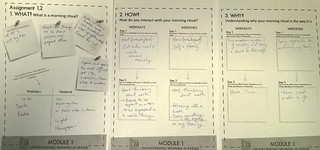 |
| The 'what', 'how' and 'why' |
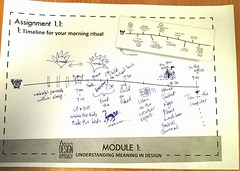 |
| The timeline of a morning |
Thursday, September 24, 2015
Contesting the shape of technology
Terra incognita is a term derived from cartography and designates undiscovered lands; lands that are unknown, unmapped and, by implication, unowned.
It is closely associated with global expansions of the European colonial era, when explorers mapped the "unknown", then (usually) claiming the lands on behalf of their sovereign.
Through military conquest or legal fiat, the terra incognita segues into terra nullius ("nobody's land") or as military prize, to become the domain of a Crown or State.
The same process also corresponds to the domination, subjugation and alienation of indigenous peoples, through conquest or the law.
How might these consequential topics, linked with the great voyages of 'discovery', cartography, and conquest relate to contemporary high-tech design initiatives?
The concept of a terra incognita can be applied to technological feature topologies.
In this sense the terra incognita hints at the design and features of an emerging technology are as yet undetermined, unknown, or open to negotiation.
By considering an emerging technology to be a malleable resource, as a "terra incognita", diverse actors will engage in technological land-grabs in order to take ownership or control of the future shape of that technology.
Systems and technology designs are a kind of property, and the technology for public services is a kind of public property.
Contests for control and power take place for project resources but more significantly for the potentially preferable, desirable, lucrative or advantageous directions that design decisions may lead to.
Ownership or control of the features of a future technology is important because technology can become a "resource for", an instrument or system yielding power, money, influence etc.
And so it turns out that contests to control the shape of emerging technology are actually contests for the opportunity, if not the right, to shape social institutions.
It is closely associated with global expansions of the European colonial era, when explorers mapped the "unknown", then (usually) claiming the lands on behalf of their sovereign.
Through military conquest or legal fiat, the terra incognita segues into terra nullius ("nobody's land") or as military prize, to become the domain of a Crown or State.
The same process also corresponds to the domination, subjugation and alienation of indigenous peoples, through conquest or the law.
How might these consequential topics, linked with the great voyages of 'discovery', cartography, and conquest relate to contemporary high-tech design initiatives?
The concept of a terra incognita can be applied to technological feature topologies.
In this sense the terra incognita hints at the design and features of an emerging technology are as yet undetermined, unknown, or open to negotiation.
By considering an emerging technology to be a malleable resource, as a "terra incognita", diverse actors will engage in technological land-grabs in order to take ownership or control of the future shape of that technology.
Systems and technology designs are a kind of property, and the technology for public services is a kind of public property.
Contests for control and power take place for project resources but more significantly for the potentially preferable, desirable, lucrative or advantageous directions that design decisions may lead to.
Ownership or control of the features of a future technology is important because technology can become a "resource for", an instrument or system yielding power, money, influence etc.
And so it turns out that contests to control the shape of emerging technology are actually contests for the opportunity, if not the right, to shape social institutions.
Friday, September 11, 2015
Efficient way to anonymise interviewee identities for academic research
The question was discussed on tex.stackexchange.com
I'm looking for an efficient way to anonymise interviewee identities using a pseudonym list.
Case studies often use direct quotation from interviews and observational data.
In these cases it is usual to identify the speakers using a pseudonym and/or role label.
Anonymisation attempts to preserve the privacy of research subjects, following the 'do no harm' principle of social and human sciences research ethics.
Using a pseudonym preserves source attribution (i.e. justifies that the quote is an example of actual empirical evidence).
I expect that this requirement is a bit like creating a glossary, a register of names or list keywords used in a document (i.e. create-a-register-of-persons-with-biblatex or create-a-register-of-persons-with-references)
I imagine writing the quotes with correct attribution in my latex document, and they will be replaced when typesetting.
Something like \person{joe} and \personrole{ceo} and a catalogue command like \dramatispersonae that produces a register of the pseudonyms and their roles in a section, somewhat like a glossary, or characters of a play, the dramatis personae.
Perhaps I could do this with bibtex, but I need to the dramatis personae to be separate from the bibliography.
Notes:
I'm not referring to approaches for censoring, redacting or 'blinding' text (i.e. efficient-ways-to-anonymize-a-document)
{best-practices} {journal-publishing} {bibliography}
I'm looking for an efficient way to anonymise interviewee identities using a pseudonym list.
Case studies often use direct quotation from interviews and observational data.
In these cases it is usual to identify the speakers using a pseudonym and/or role label.
Anonymisation attempts to preserve the privacy of research subjects, following the 'do no harm' principle of social and human sciences research ethics.
Using a pseudonym preserves source attribution (i.e. justifies that the quote is an example of actual empirical evidence).
I expect that this requirement is a bit like creating a glossary, a register of names or list keywords used in a document (i.e. create-a-register-of-persons-with-biblatex or create-a-register-of-persons-with-references)
I imagine writing the quotes with correct attribution in my latex document, and they will be replaced when typesetting.
Something like \person{joe} and \personrole{ceo} and a catalogue command like \dramatispersonae that produces a register of the pseudonyms and their roles in a section, somewhat like a glossary, or characters of a play, the dramatis personae.
Perhaps I could do this with bibtex, but I need to the dramatis personae to be separate from the bibliography.
Notes:
I'm not referring to approaches for censoring, redacting or 'blinding' text (i.e. efficient-ways-to-anonymize-a-document)
{best-practices} {journal-publishing} {bibliography}
Subscribe to:
Posts (Atom)
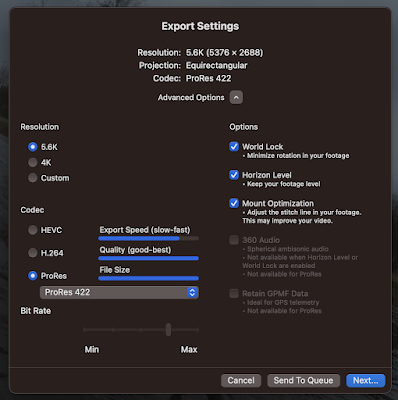
Sharing 360° video?
So, you've got a 360 degree video file from your GoPro. What to do with it? Well, share it on YouTube. YouTube supports uploading and pl...
-
 So, you've got a 360 degree video file from your GoPro. What to do with it? Well, share it on YouTube. YouTube supports uploading and pl...
 -
(CTAN, a meta-level resource for all things TeX www.ctan.org/ ) Step 1: MacTeX packages for Mac. Install MacTeX, after which do the foll...
-
First, read the article "AI-generated art illustrates another problem with technology" by John Naughton on the Guardian (20 Aug...