Introduction
A case is a story, so it has to be interesting, like a story, with a narrative, told and holding to whatever genre is chosen (confessional, detective, fiction, non-fiction).
Cases are also stories, backed up with evidence.
Like any story it needs strong characters, characters written with personalities.
Although unlike stories cases depend on data, on evidence offered in different ways.
Evidence may be peppered or buried within the case narrative, or it may be provided in appendices.
Furthermore, cases are driven by or offer challenges.
Cases generally problematise something or construct a nexus, a point in time, in tension, a point at which key decisions.
However a case may also present an on-going situation rather than a crisis.
Structure
The opening paragraph is the hook.
All writers succeed or fail at the opening.
The first sentence, the first paragraph will either offer your reader an inducement to continue, or put them off.
Exhibits and appendix:
When starting to write a case it may be helpful to prepare the case notes in advance.
For example, corporate results, policy documents or summary, an advertisement, a job description, a cost spreadsheet, a definition, an anecdote, a timeline, samples of before or after artifacts for contrast etc.
A group template
Teaching notes:
Typically teaching notes are x2 pages longer than the case.
How would you use the case for a one class period.
Can the case be used for multiple classes?
Consider one particular overarching question per lesson period.
Teaching notes would tend to include variant lesson plans, structured exercises.
Offer worksheets for use by students perhaps including one or more of the following...
A case may be used to apply two or three different theoretical frameworks e.g. knowledge management, governance, dimensions of distance, supplier perspective, client perspective, lifecycle perspective, technology, power etc. PEST (Political, Economic, Social and Technological) factors, Porter five forces, SWOT, stakeholder analysis, resource analysis,
What kind of case is it?
A capstone case dealing with strategic management?
A mini case dealing with outsourcing governance?
Monday, March 30, 2015
Monday, March 2, 2015
EndNote Web at UCD
Following the tips at UCD's Introduction to EndNote page (link).
- You'll need to sign in or register to Web of Science.
- Once the account is registered you can access EndNote web from any browser via http://www.myendnoteweb.com/

The evolution of the Postcode issue in Ireland (2006-2010)
PA Consulting Group produced the "The Monetary Cost and Benefits Analysis Report" of 2006 produced as a contracted input to the newly appointed NPPB. The report opened with the claim that "the utility value of the postcode has increased dramatically with it now being used across a broad range of activities including, the ordering of a taxi, the planning major infrastructure investments, the assessment of risk and the identification of customers in call centre interactions." This variation on previous lists of benefits in the first paragraph of the report, provided a clear statement of priority.
The CBA report drew on input from 55 stakeholder groups and identified overwhelming support for and perceived value in a National Postcode system. The method used aggregation/extrapolation of representative or estimated costs/benefits at the level of individual entities (consultees), aggregated to industry sector then aggregated to national economy level. The findings were that for the Postal Sector a postcode implementation cost would be ~13.1Million with an on-going annual cost of ~2.2Million. Identified benefits were listed as 1) A saving of up to €0.20 cents per item delivered with the use of a postcode. 2) Improved data quality in databases held by stakeholders. 3) Improved data analysis producing savings, CSO indicated an improvement of 0.2% efficiency would save ~€65Million of voted Government expenditure (p vi). 4) Enhanced services for customers, e.g. reduced on-line or on-call times with customer service operators. Notably the monetary CBA report contrasted the anticipated postcode take-up rate in Ireland with those from Portugal and Northern Ireland to make predictions on the business case (appendix B).
It also referred to the eventual installation of the postcode management licence holder (PMLH) to operate the National Postcode contract. The major deliverable being a PAD (postal address database) with addresses associated with correctly assigned postcodes. The anticipated PAD would contain a geo-referenced address database, postcode boundary definition, and require on-going postcode boundary/geo-location assignment to addresses, maintenance. Notice was also drawn to the IPR (intellectual property right) potential of the PAD and its need for the property to reside with the state, albeit the PMLH would be responsible for managing the resource.
Design considerations circa 2006
The software consultancy services firm, Version 1, had been contracted to produce a technical specification on 22 Dec 2005. The eventual technical design document (22 pages long) provided a list of 36 different postcode models from which a shortlist of 5 models were short-listed and then further reduced to three. Analysts took account of requirements from: the NSB (National Statistics Board), ISDI (the Irish Spatial Data Infrastructure initiative), public agencies authorities and utilities already compiling and managing spatial databases, postal operators (An Post) and the legal requirement for USO (Universal Service Obligation).
However the Data Protection Commissioner rejected the ‘One-to-One’ postcode-identity model (letter of 26 June 2006), stating that it should not be adopted as it enabled the ready identification of individuals, citing the examples of postcode being used to "identify patterns of crime or illness."(p38, C-2). Therefore a 1:1 PAD would not be desirable, and that any public database linking addresses with geo-coordinates would require a public debate and legal certainty in order to address possible threats to privacy. The Commissioner advised the general principle that the postcode should not allow a property and therefore a family to be identified (NPPB, 2006: Appendix), judging that allocating "a postcode to each individual property would be viewed as intrusive and an infringement of privacy rights." Even if a code did not resolve an individual level, it might still "allow the identification of the ‘family’ and from a data protection perspective, this was not acceptable." (NPPB, 2006: p4).
It was also envisaged that the Government's own Small Area Spatial Code initiative for electoral subdivisions, census returns etc. would also align with postcode area maps although the systems under consideration did not envisage encoding geo-code data in the postcode. A 'blockface centroid' (centre of the polygon describing a postcode area) could be stored as a lookup field in the PAD (postal address database). The principle of non-identification of the individual effectively determined that the areas encompass multiple addresses and ruled out public access to fine grained geo-coordinate data in or associated with the postcode. The data protection principle required that internal geo-codes could only be used for the delivery of mail and not made publicly accessible.
The design specification elaborated on three technical design options: 1) Post-town boundary model. 2) Fixed grid model. 3) Postal sector model. It also presented an operational specification and allocation specification. However, without geo-coordinates it would not enable fine location of non-addressable objects such as bridges, electricity poles, transformers, pump stations, signage, traffic lights etc. used by utility services. The eventual recommendation was for a postcode of the form [ABC] [123]. The format would aid memorability, with the first three characters representing an alpha/alphanumeric abbreviation of the post-town (or existing postcode in the case of Dublin) and the last three numbers acting as a code for a small spatial area.
The NPPB approved the recommendation for a route based postcode system based on Postal-Towns and of the form [ABS] [123] collinear with the small spatial area model (e.g. street side, block, sector, area) but not so small as to publicly identify individuals and addresses. Where non-unique addresses arose e.g. where roads or houses were not currently numbered or named, it was proposed that numbered or named within the scope of the Postcode implementation project.
The NPPB also recommended that the postcode system be operated under a license holder governance model in which the postcode management would be tendered for commercial contract. The Postcode Management Licence Holder (PMLH) option was seen to be preferable due to its perceived independence and the ready availability of expertise in the private sector as opposed to the government sector.
From Postcode to Address-code; reports and revisions to the postcode project: 2008 - 2010
The period 2008-2010 is marked by a little apparent progress on the postcode project. Postcodes no longer appeared as a strategic issue in ComReg reports now that it had moved under the aegis of the NPPB. The issue also appeared to have moved off the political agenda, making progress slowly in the background.
At the 2007 conference "Postal Services in the 21st Century" Chris Osborne, who had been commissioned by ComReg to research and report on the benefits of opening the postal market to competition, stated that the lack of a public postcode or postcode access file posed a "significant barrier to entry" for new suppliers in the postal services market. Osborne stated that stakeholders believed that rural delivery still required local knowledge. He also claimed that the An Post Group of Trade Unions acknowledged that a public postcode would reduce the margins and profits that An Post received from the Direct Mail industry, that it used in turn to cross fund the Universal Service Provision.
By September 2008, two years after the results of the original comprehensive consultation, PA Consulting produced an updated business case for postcodes. This report appeared to reopen the project requirements and specification by focusing on the benefits to Government Departments. It considered the views of the Departments of: Agriculture, Environment Heritage and Local Government, Health & Children, Social & Family Affairs, Transport, and the Revenue Commissioners.
The results indicated further support for the introduction of a postcode system but they also raised doubts about the suitability of the proposed six character system itself. The concerns included the need for coherence between the postcode system and "Atomic Small Areas" (ASAs) by the Dept of Environment, Heritage & Local Government). The desire to “harness the full potential of a modern geo-referencing system” expressed by the Dept of Health and Children. And the Dept of Transport expressed a desire for a grid-based model to allow referencing of infrastructural objects on a whole-country basis.
In contrast with the assessment from 2006 the 2008 report advised that the 2006 Implementation costs were understated by €1,737,336, maintenance costs were overstated by €14,579, and monetary benefits were understated by €3,345,367 per annum (p6). Overall it was estimated that quantifiable benefits would amount up to €22m 15 years (p6).
In April 2010 the Joint Oireachtas Committee on Communications, Energy and Natural Resources reported on the Postcodes project. This report dealt explicitly with the opinion of the Data Protection Commissioner in 2006, that allocating postcode to each address would be intrusive and raise privacy issues. The committee found that "The postcode relates not to the person but to the property. If a person moves house they do not take their postcode with them." (p22) The committee determined as follows:
"1. It is recommended that the Data Protection Commissioner be requested to consider afresh his advice already set out in 2006. It may be that, in light of new technologies, a different approach is possible.
2. Legal opinion should also be sought to assess the implications of the advice of the Data Protection Commissioner before any final decision on the project is made and, if necessary, new legislation should be considered by the government." (p23)
In arguing for an address code as opposed to a postal-sector code the committee quoted a major Irish bank's claim that "precise addressing of every deliverable address in Ireland... "should lead to improvements... (in) Customer Identification and Data Protection." (p26)
Further support for a postcode design that incorporated individual address codes was offered by the Health Intelligence section of the Health Service Executive. In a letter from the HSE (appendix 1) it was stated "that an area based system (hide one property within so many other properties which may be miles apart) is inappropriate, unnecessary, outdated and a waste of resources". The letter outlined sixteen benefits of a location postcode, including spatial analysis of health issues, stating that an area based system could not overcome the non-unique address problem and or improve equity of service response between rural and urban areas, both identified as 'fatal limitations' of an area code" system (p37). Prof. A Stewart Fotheringham of the National Centre for Geocomputation at NUI Maynooth provided further arguments in support of a postcode that referenced at the level of individual buildings.
By December 2010, the Department of Communications, Energy and Natural Resources (DCENR) sought an update on the proposal requirements and cost-benefit analysis in 2010 (ref) in advance of commending the procurement process to award a Postcode Management License Holder (PMLH) and contract the implementation of the National Postcode System (NPS). PA Consulting Group was again responsible for producing the report.
This report incorporated the intent of the Oireachtas Committee including estimates of the costs of implementing a 'postal sector model' compared with a 'refined postal sector model'. The 'refined postal sector model' (a postal address code rather than a postcode) would provide 'unique address point identification' which it was claimed would produce significant benefits. Under the heading "Optimum Technical Specification" the report stated that "In order to further magnify the extent of the benefits identified in this report it shall be necessary to refine the model as proposed by the NPPB to facilitate unique address identification". No further mention was made of the earlier concerns raised by the Data Protection Commissioner in 2006 regarding the perceived issues of mapping a code to each individual addressable property. The resolution of this objection presumably being satisfied following the deliberations of the Joint Oireachtas Committee on Communications, Energy and Natural Resources (Oireachtas, 2010).
plotly
plotly may be worth considering for graphing and visualisation. An example of someone's graph of their personal weather station data.
https://plot.ly/~flann321/9/
https://plot.ly/~flann321/9/
Sunday, February 22, 2015
The evolution of the Postcode issue in Ireland (1991-2005)
In 1991 the European Community and European Commission initiated a process to enable competition, transform, reform and better regulate postal services within the EU.
It took until 2000 for directive 97/67/EC to be transposed into Irish law under the “European Communities (Postal Services) Regulations 2000”3. The following year Ireland’s Office of the Director of Telecommunications Regulation (OTDR) established a public protocol and procedure for taking account of the views of parties interested in the sectors under her control. A particular responsibility of the OTDR was to manage the definition of Ireland’s interpretation of the Universal Service Obligation (USO) and to monitor and regulate the performance of mandated universal postal service providers4. The USO applied to the public collection and delivery of mail.
Universal service providers must guarantee one clearance, and subject to derogation, one delivery to the address of every natural or legal person in the State five days a week.(Director of Telecommunications Regulation, 2001, pp. 3)
The USO defined a ”Reserved Area”, a designated legal monopoly in which mail services were supplied as a type of public good, albeit one that should be paid for by its users. However close regulation of the reserved monopoly was required by law to ensure that price setting was fair and that designated Universal Service Providers would not subsidise operations from a competitive area with profits from a Reserved Area activity or vice versa, thereby gaining unfair competitive advantage.
The Irish postal service had heretofore operated according to a simple, perhaps elegant, balancing rule based on population density, collection point location and delivery frequency. Each collection point (postbox) is maintained and monitored according to the anticipated volume of items posted balanced against distance between collection points rather than according to predesignated Postcode areas. Similarly delivery routes, while relatively stable and based around the concept of post towns, may change in coverage, breadth, depth and frequency according to season, use, and social concentration. The policy as operated by An Post has allowed for responsive adaptation to demographics, changing volumes and composition of mail. And although the very idea of a postcode is ubiquitous and is an implicit understanding of what constitutes a post service in the vast majority of countries, somehow Ireland, contrary to the experience of the rest of the World, has achieved all this without using a national postcode system. Ireland’s An Post achieves this using OCR (optical character recognition), a comprehensive and accurate address database, automated sorting machinery, internal routing, planning and logistics systems hidden within its delivery apparatus.
Against this backdrop, directive 97/67/EC was introduced, aiming to address two potentially contradictory principles: the continuing provision of an affordable high quality universal postal service for society in each member state, but to also open postal services to competition through liberalisation of the postal market. In 2002 the Director of Telecommunications Regulation opened a consultation process into the status of Postcodes in Ireland. (Office of the Director of Telecommunications Regulation, 2002) The Director opened the consultation with the following statement...
“The paper also raises the very interesting question of why Ireland is only one of two countries in the EU without a proper Postcode system.” [emphasis added]
...and that “Apart from Greece, Ireland is the only European member state that does not use a postal coding system.”
Office of the Director of Telecommunications Regulation (2002, pp. 6)
The consultation paper went on to pose the following questions to stakeholders “What do you see as the advantages and disadvantages of introducing Postcodes in Ireland? Which would be the most appropriate organisation to allocate them, and how should it be funded?” Office of the Director of Telecommunications Regulation (2002, pp. 21) It dealt specifically with the problem of correct addressing and focused on the use of postcodes to improve this issue. Four examples of confusing addresses were provided (no personal detail, simply village or town name and two or three alternate county locations). The argument drew on the Universal Postal Union’s belief that a postcode is a fundamental, essential element of an address and that of 105 UPU members, only Ireland and Greece, within the EU, do not use a postcode. The regulator also referred to bulk mail providers (then An Post’s own customers) seeking the introduction of an agreed Postcode system and barcoding in order to pre-code and pre-sort mail, in order to pay lower fees. Mention was also made of Utility and Emergency services desiring to use a National Postcode system to improve location identification. The final case was of the benefit to firms using Postcodes in other countries for credit scoring consumers and customer relationship management systems.
In December 2002 the Commission for Communications Regulation (ComReg) was founded and replaced the Office of the Director of Telecommunications Regulator (ODTR). Etain Doyle, the previous Director of Telecommunications Regulation was appointed the first chairperson of the Commission.
On the 18th of December 2002 ComReg extended the deadline for submissions on the consultation started by the OTDR. The announcement stated
“it appears that there is a significant case for the introduction of Postcodes in Ireland”, then continued; “While An Post do not currently see the need for such a system there are many other players in the Postal Sector and wider who say they would like to see Ireland using the same system as most other countries.” Commission for Communications Regulation (2002)
On 13 May 2003 ComReg released its decision notice and response to the consultation process. In introducing this report Etain Doyle restated the key motivations for the consultation, in particular addressing “the very interesting question of why Ireland is one of the few countries without a proper Postcode system.” (Commission for Communications Regulation, 2003)
The consultation had unexpectedly attracted over one thousand responses, private citizens had reacted to a proposal to mandate the introduction of rural roadside letter boxes for delivery rather than delivery to addresses. On the proposal for a national postcode system it seemed “...that the case for postcodes is even stronger than we believed.” (Commission for Communications Regulation, 2003, pp. 6).
There was broad support from industry, from bulk mailer business, utilities and emergency services. It was noted that such a postcode system would help “facilitate credit scoring by financial institutions, health risk analysis by the Health Boards and other bodies who depend on statistical information in the compilation of various studies of general interest.” (Commission for Communications Regulation, 2003, pp. 42). The Central Statistics Office (CSO) stated “there would be major benefits to the overall statistical system.” Some respondents went so far as to propose Postcode designs and drafts of systems. In contrast An Post did not support the idea of introducing a National postcode, arguing that it was unnecessary given the proven effectiveness of its OCR, address database and automated sorting facility. An Post also pointed out that eventual user adoption and compliance could be problematic and likely result in problems and confusion.
However many rural respondents voiced opposition to the introduction of Postcodes. ComReg observed that:
“the basis for opposition was primarily in relation to the loss of townland names and the strong local history which was part and parcel of those names. Others objected stating that it would only create another layer on the address, that the knowledge of the local post person was sufficient to ensure delivery to the correct address.” (Commission for Communications Regulation, 2003)
ComReg determined however that there was an...
“overwhelming case for investigating the issue of introducing a postcode system in Ireland particularly when the An Post postman is no longer the only person making deliveries. ” (Commission for Communications Regulation, 2003, pp. 43)
ComReg’s position was clearly informed by the intent of Directive 97/67/EC in which it was envisaged that multiple Universal Service Providers could operate the USO under license by the Government. A public National Postcode system facilitating address disambiguation would facilitate this strategy. ComReg concluded however by stating that further investigation was necessary and proposed to convene a National conference to gather all stakeholders to further consider the issue of introducing a postcode system into Ireland.
At the Symposium on Postcodes in 24 November 2003 the chairperson of ComReg, Etain Doyle, set out the case for introducing a Postcode system. In spite of An Post’s achievement in applying OCR, their address database and automated sorting technology so that, for An Post at least, a Postcode for address disambiguation was unnecessary, Doyle stated that “postal services are no longer the preserve of national state-owned Post Offices”. (Doyle, 2003) Doyle concluded by stating that a publically available Postcode was necessary for service providers both within the postal sector and beyond. Further, by virtue of being publically available, simple and intuitive, that a National Postcode may even replace map references or Geo codes for location finding. Discussing public concerns of the possible loss of townland names and the cultural connections between place names, people and local history, she called the issue a “red herring”, stating that “You can have codes for the existing names right down to individual houses.” Doyle posited the case of a woman attending a clinic to screen for breast cancer and the possible ways her address (Ballylanders) may become disconnected from the actual location (in Limerick or Cork?). She offered other examples highlighting the value of postcodes to facilitate internet and telesales, enable direct mail marketing, simplify the centralisation or outsourcing of services so that local knowledge would no be longer required, and its use to utility companies and emergency services to quickly identify address locations. In terms of other benefits, a public alternative to An Post’s internal address identification system would reduce An Post’s unintended competitive advantage and act as an enabler for competition in the Irish market for Postal services.
“The volume of mail delivered to each household in Ireland is among the lowest in Europe, largely because the Direct Mail market is so underdeveloped. If postcodes had been introduced 10 or 20 years ago, when they were being introduced in other countries, would this most important part of the postal sector have developed differently? Would the introduction of a postcode now help to address this deficit?” (Doyle, 2003)
Four days after the Symposium on Postcodes ComReg launched a new public consultation specifically on Postcodes. The consultation document set out and explained the drivers for a public Postcode system and asked 13 new consultation questions related to the Postcode issue. The arguments put forward for a public National Postcode system included:
1. An Post’s own system was costly and difficult to port into other organisations and it had no user facing element.
2. A new postcode would take advantage of the most modern current technology.
3. It would assist emergency and utility services.
4. Facilitate electronic commerce and Internet services that require postcode information for user/address validation.
5. Reduce the potential for post delivery errors due to address ambiguity.
6. To facilitate direct mail marketing industry.
7. Simple intuitive postcodes could help people reach destinations.
8. It could help spatial epidemiological (medical) research.
9. It would help spatial research of social and economic programmes.
On 26 January 2005, ComReg released its report on the Postcode debate spanning its development over 2001-2003 and ComReg’s own subsequent research (Commission for Communications Regulation, 2005d). The report stated that there was broad support for the introduction of a public Postcode, detailing the benefits of the proposed change and introducing a principles based approach for how the Postcode and associated systems would be realised. It also took great care to address the concerns that had been expressed by the general public around the loss of placenames in addresses and their links with local culture and heritage. The report also organised the benefits of a public National Postcode under three broad themes rather than as a lists of benefits/benefactors.
The three thematic principles/goals were:
1. Providing a unique address without loss of local identity.
2. innovation, efficiency and competitiveness.
3. Government sector desire for a Small Area Spatial Code.
A crucial issue was to overcome how post delivery currently relied on personal ’local knowledge’. Isolde Goggin, the new Chairperson of ComReg, explained that the need for a unique address could be achieved without any loss of local identity.
“An Post had traditionally relied on the local knowledge of the postman and his/her familiarity with the addresses served, in order to effect correct delivery.” (Commission for Communications Regulation, 2005d)
Deep local knowledge is implicitly valued in Irish society. However commercial enterprises, in this case other Postal Service providers, encounter barriers to entry to the postal market because this local, contextual knowledge is not codified. An Post inadvertently benefits from its long term social and technological investment in learning and sustaining local knowledge, obviating the need for public spatial codes in addresses in order to facilitate postal sorting. Whereas other suppliers and stakeholders insist that the “availability of a public postcode is a vital aspect of the national economic infrastructure.” If instead there was a freely accessible public national postcode system it would lower the barriers to spatial address data for all stakeholders. A public postcode would also allow International companies to achieve the correct routing of addresses that may also, by right, be written in Irish. A postcode could overcome the need for Irish language translation and local knowledge.
On January 26 2005 The Chairperson of ComReg announced that...
“Having considered all the submissions and arguments for and against, ComReg believes that there is broad support for the introduction of postcodes to Ireland. The evidence from other countries demonstrates that the use of postcodes can contribute to competitiveness and national development. ComReg also believes that it is possible to introduce a system of postcodes that will not affect historical and traditional townland names, particularly in rural areas. ” (Commission for Communications Regulation, 2005a)
This report adopted a more conciliatory note on the relationship with An Post than previously and stated that “a postcode system in Ireland should therefore be developed by all postal service providers for the benefit of that sector as a whole.” (Commission for Communications Regulation, 2005d). It highlighted An Post’s stated preparedness to work with a public postcode although it had neither the finances or resources to develop the system independently.
ComReg then proposed the formation of a new working group involving all key actors in the postal services industry and tasked with producing an outline business case and implementation plan for a new national postcode. ComReg set out additional specific and general requirements or issues to be addressed by the working group and referred to the Government decision in favour of a public postcode. The working group returned with its report of April 2005 recommending the following \citep{The2005aa}
The initiative was also linked to the Cabinet decision supporting the report of the Steering Group on Social and Equality Statistics (SGSES) which proposed a national system of spatial classification to facilitate the Government and other public agencies.
The Small Area Spatial Code initiative incorporated the specific spatial coding requirements of the National Statistics Boar (NSB), Senior Officials Group on Social Inclusion (SOGSI), Central Statistics Office (CSO), National Economic and Social Council (NESC), and the Steering Group on Social and Equality Statistics (SGSES).
7 principles were proposed that the Postcode proposal should satisfy (Commission for Communications Regulation, 2005d)...:
1. It must be a public code.
2. Depth of coding to be structured to the level of specific spatial areas.
3. It must be easily memorised.
4. It must not require changes in the names of peoples’ townland, parish or county.
5. It must be competitively and socially neutral.
6. It must be self financing and/or of minimal cost to use.
7. And an appropriate public ownership structure (IPR) must be agreed.
The National Postcode Project Board (NPPB) was appointed and its first meeting took place on May 1 2005. Tasked by Noel Dempsey, Minister for Communications, Marine and Natural Resources, it was to represent stakeholders and govern the Postcode project. Soon after (23 May), on the instruction of the minister, ComReg announced its intention to hold a tender process for the design of the public postcode system (Commission for Communications Regulation, 2005b) for implementation and roll-out on January 1, 2008 (2005_Update31May-3June2005.doc).
The design contract was eventually awarded to ’Version 1 Software’ (on 22 December 2005) for a technical specification for a public postcode system in Ireland (Commission for Communications Regulation, 2005c) and PA Consulting was contracted to conduct a cost-benefits analysis and additional requirements gathering.
0.1.1 Postal reform
The move towards postal service reform commenced with the publication of a Green Paper opening a public consultation on the development of a single market for postal services (COM(91) 476 final)1. The process culminated in directive 97/67/EC2 of the European Parliament and Council of 15 December 1997. The directive established common rules for the development of the internal market of Community postal services and improvement of quality of service. Directive 97/67/EC “put in place a harmonised regulatory framework for the Community postal sector and defined the decision making process regarding further opening of the postal market to competition.” Director of Telecommunications Regulation (2001).It took until 2000 for directive 97/67/EC to be transposed into Irish law under the “European Communities (Postal Services) Regulations 2000”3. The following year Ireland’s Office of the Director of Telecommunications Regulation (OTDR) established a public protocol and procedure for taking account of the views of parties interested in the sectors under her control. A particular responsibility of the OTDR was to manage the definition of Ireland’s interpretation of the Universal Service Obligation (USO) and to monitor and regulate the performance of mandated universal postal service providers4. The USO applied to the public collection and delivery of mail.
Universal service providers must guarantee one clearance, and subject to derogation, one delivery to the address of every natural or legal person in the State five days a week.(Director of Telecommunications Regulation, 2001, pp. 3)
The USO defined a ”Reserved Area”, a designated legal monopoly in which mail services were supplied as a type of public good, albeit one that should be paid for by its users. However close regulation of the reserved monopoly was required by law to ensure that price setting was fair and that designated Universal Service Providers would not subsidise operations from a competitive area with profits from a Reserved Area activity or vice versa, thereby gaining unfair competitive advantage.
0.1.2 Problematising the absence of a postcode
The Irish postal service had heretofore operated according to a simple, perhaps elegant, balancing rule based on population density, collection point location and delivery frequency. Each collection point (postbox) is maintained and monitored according to the anticipated volume of items posted balanced against distance between collection points rather than according to predesignated Postcode areas. Similarly delivery routes, while relatively stable and based around the concept of post towns, may change in coverage, breadth, depth and frequency according to season, use, and social concentration. The policy as operated by An Post has allowed for responsive adaptation to demographics, changing volumes and composition of mail. And although the very idea of a postcode is ubiquitous and is an implicit understanding of what constitutes a post service in the vast majority of countries, somehow Ireland, contrary to the experience of the rest of the World, has achieved all this without using a national postcode system. Ireland’s An Post achieves this using OCR (optical character recognition), a comprehensive and accurate address database, automated sorting machinery, internal routing, planning and logistics systems hidden within its delivery apparatus.
0.1.3 Consultation, using postcodes as a lever to enable competition
Against this backdrop, directive 97/67/EC was introduced, aiming to address two potentially contradictory principles: the continuing provision of an affordable high quality universal postal service for society in each member state, but to also open postal services to competition through liberalisation of the postal market. In 2002 the Director of Telecommunications Regulation opened a consultation process into the status of Postcodes in Ireland. (Office of the Director of Telecommunications Regulation, 2002) The Director opened the consultation with the following statement...
“The paper also raises the very interesting question of why Ireland is only one of two countries in the EU without a proper Postcode system.” [emphasis added]
...and that “Apart from Greece, Ireland is the only European member state that does not use a postal coding system.”
Office of the Director of Telecommunications Regulation (2002, pp. 6)
The consultation paper went on to pose the following questions to stakeholders “What do you see as the advantages and disadvantages of introducing Postcodes in Ireland? Which would be the most appropriate organisation to allocate them, and how should it be funded?” Office of the Director of Telecommunications Regulation (2002, pp. 21) It dealt specifically with the problem of correct addressing and focused on the use of postcodes to improve this issue. Four examples of confusing addresses were provided (no personal detail, simply village or town name and two or three alternate county locations). The argument drew on the Universal Postal Union’s belief that a postcode is a fundamental, essential element of an address and that of 105 UPU members, only Ireland and Greece, within the EU, do not use a postcode. The regulator also referred to bulk mail providers (then An Post’s own customers) seeking the introduction of an agreed Postcode system and barcoding in order to pre-code and pre-sort mail, in order to pay lower fees. Mention was also made of Utility and Emergency services desiring to use a National Postcode system to improve location identification. The final case was of the benefit to firms using Postcodes in other countries for credit scoring consumers and customer relationship management systems.
0.1.4 ComReg and a postcode in its sights
In December 2002 the Commission for Communications Regulation (ComReg) was founded and replaced the Office of the Director of Telecommunications Regulator (ODTR). Etain Doyle, the previous Director of Telecommunications Regulation was appointed the first chairperson of the Commission.
On the 18th of December 2002 ComReg extended the deadline for submissions on the consultation started by the OTDR. The announcement stated
“it appears that there is a significant case for the introduction of Postcodes in Ireland”, then continued; “While An Post do not currently see the need for such a system there are many other players in the Postal Sector and wider who say they would like to see Ireland using the same system as most other countries.” Commission for Communications Regulation (2002)
On 13 May 2003 ComReg released its decision notice and response to the consultation process. In introducing this report Etain Doyle restated the key motivations for the consultation, in particular addressing “the very interesting question of why Ireland is one of the few countries without a proper Postcode system.” (Commission for Communications Regulation, 2003)
The consultation had unexpectedly attracted over one thousand responses, private citizens had reacted to a proposal to mandate the introduction of rural roadside letter boxes for delivery rather than delivery to addresses. On the proposal for a national postcode system it seemed “...that the case for postcodes is even stronger than we believed.” (Commission for Communications Regulation, 2003, pp. 6).
There was broad support from industry, from bulk mailer business, utilities and emergency services. It was noted that such a postcode system would help “facilitate credit scoring by financial institutions, health risk analysis by the Health Boards and other bodies who depend on statistical information in the compilation of various studies of general interest.” (Commission for Communications Regulation, 2003, pp. 42). The Central Statistics Office (CSO) stated “there would be major benefits to the overall statistical system.” Some respondents went so far as to propose Postcode designs and drafts of systems. In contrast An Post did not support the idea of introducing a National postcode, arguing that it was unnecessary given the proven effectiveness of its OCR, address database and automated sorting facility. An Post also pointed out that eventual user adoption and compliance could be problematic and likely result in problems and confusion.
0.1.5 Identification with place
However many rural respondents voiced opposition to the introduction of Postcodes. ComReg observed that:
“the basis for opposition was primarily in relation to the loss of townland names and the strong local history which was part and parcel of those names. Others objected stating that it would only create another layer on the address, that the knowledge of the local post person was sufficient to ensure delivery to the correct address.” (Commission for Communications Regulation, 2003)
ComReg determined however that there was an...
“overwhelming case for investigating the issue of introducing a postcode system in Ireland particularly when the An Post postman is no longer the only person making deliveries. ” (Commission for Communications Regulation, 2003, pp. 43)
ComReg’s position was clearly informed by the intent of Directive 97/67/EC in which it was envisaged that multiple Universal Service Providers could operate the USO under license by the Government. A public National Postcode system facilitating address disambiguation would facilitate this strategy. ComReg concluded however by stating that further investigation was necessary and proposed to convene a National conference to gather all stakeholders to further consider the issue of introducing a postcode system into Ireland.
0.1.6 The Symposium on Postcodes
At the Symposium on Postcodes in 24 November 2003 the chairperson of ComReg, Etain Doyle, set out the case for introducing a Postcode system. In spite of An Post’s achievement in applying OCR, their address database and automated sorting technology so that, for An Post at least, a Postcode for address disambiguation was unnecessary, Doyle stated that “postal services are no longer the preserve of national state-owned Post Offices”. (Doyle, 2003) Doyle concluded by stating that a publically available Postcode was necessary for service providers both within the postal sector and beyond. Further, by virtue of being publically available, simple and intuitive, that a National Postcode may even replace map references or Geo codes for location finding. Discussing public concerns of the possible loss of townland names and the cultural connections between place names, people and local history, she called the issue a “red herring”, stating that “You can have codes for the existing names right down to individual houses.” Doyle posited the case of a woman attending a clinic to screen for breast cancer and the possible ways her address (Ballylanders) may become disconnected from the actual location (in Limerick or Cork?). She offered other examples highlighting the value of postcodes to facilitate internet and telesales, enable direct mail marketing, simplify the centralisation or outsourcing of services so that local knowledge would no be longer required, and its use to utility companies and emergency services to quickly identify address locations. In terms of other benefits, a public alternative to An Post’s internal address identification system would reduce An Post’s unintended competitive advantage and act as an enabler for competition in the Irish market for Postal services.
“The volume of mail delivered to each household in Ireland is among the lowest in Europe, largely because the Direct Mail market is so underdeveloped. If postcodes had been introduced 10 or 20 years ago, when they were being introduced in other countries, would this most important part of the postal sector have developed differently? Would the introduction of a postcode now help to address this deficit?” (Doyle, 2003)
0.1.7 Yet another consultation
Four days after the Symposium on Postcodes ComReg launched a new public consultation specifically on Postcodes. The consultation document set out and explained the drivers for a public Postcode system and asked 13 new consultation questions related to the Postcode issue. The arguments put forward for a public National Postcode system included:
1. An Post’s own system was costly and difficult to port into other organisations and it had no user facing element.
2. A new postcode would take advantage of the most modern current technology.
3. It would assist emergency and utility services.
4. Facilitate electronic commerce and Internet services that require postcode information for user/address validation.
5. Reduce the potential for post delivery errors due to address ambiguity.
6. To facilitate direct mail marketing industry.
7. Simple intuitive postcodes could help people reach destinations.
8. It could help spatial epidemiological (medical) research.
9. It would help spatial research of social and economic programmes.
On 26 January 2005, ComReg released its report on the Postcode debate spanning its development over 2001-2003 and ComReg’s own subsequent research (Commission for Communications Regulation, 2005d). The report stated that there was broad support for the introduction of a public Postcode, detailing the benefits of the proposed change and introducing a principles based approach for how the Postcode and associated systems would be realised. It also took great care to address the concerns that had been expressed by the general public around the loss of placenames in addresses and their links with local culture and heritage. The report also organised the benefits of a public National Postcode under three broad themes rather than as a lists of benefits/benefactors.
The three thematic principles/goals were:
1. Providing a unique address without loss of local identity.
2. innovation, efficiency and competitiveness.
3. Government sector desire for a Small Area Spatial Code.
A crucial issue was to overcome how post delivery currently relied on personal ’local knowledge’. Isolde Goggin, the new Chairperson of ComReg, explained that the need for a unique address could be achieved without any loss of local identity.
“An Post had traditionally relied on the local knowledge of the postman and his/her familiarity with the addresses served, in order to effect correct delivery.” (Commission for Communications Regulation, 2005d)
Deep local knowledge is implicitly valued in Irish society. However commercial enterprises, in this case other Postal Service providers, encounter barriers to entry to the postal market because this local, contextual knowledge is not codified. An Post inadvertently benefits from its long term social and technological investment in learning and sustaining local knowledge, obviating the need for public spatial codes in addresses in order to facilitate postal sorting. Whereas other suppliers and stakeholders insist that the “availability of a public postcode is a vital aspect of the national economic infrastructure.” If instead there was a freely accessible public national postcode system it would lower the barriers to spatial address data for all stakeholders. A public postcode would also allow International companies to achieve the correct routing of addresses that may also, by right, be written in Irish. A postcode could overcome the need for Irish language translation and local knowledge.
0.1.8 Next steps toward a National Postcode Project
On January 26 2005 The Chairperson of ComReg announced that...
“Having considered all the submissions and arguments for and against, ComReg believes that there is broad support for the introduction of postcodes to Ireland. The evidence from other countries demonstrates that the use of postcodes can contribute to competitiveness and national development. ComReg also believes that it is possible to introduce a system of postcodes that will not affect historical and traditional townland names, particularly in rural areas. ” (Commission for Communications Regulation, 2005a)
This report adopted a more conciliatory note on the relationship with An Post than previously and stated that “a postcode system in Ireland should therefore be developed by all postal service providers for the benefit of that sector as a whole.” (Commission for Communications Regulation, 2005d). It highlighted An Post’s stated preparedness to work with a public postcode although it had neither the finances or resources to develop the system independently.
ComReg then proposed the formation of a new working group involving all key actors in the postal services industry and tasked with producing an outline business case and implementation plan for a new national postcode. ComReg set out additional specific and general requirements or issues to be addressed by the working group and referred to the Government decision in favour of a public postcode. The working group returned with its report of April 2005 recommending the following \citep{The2005aa}
1. A postcode system would have national benefits and should be commenced immediately.
2. Project managers should be appointed post haste (est charge 200-300k).
3. Project managers should be assisted by a National Postcode Project Board.
4. Project managers and proposed NPPB should conclude cost/benefit analysis for Dec 31 2005.
5. Subject to caveats the target date for implementing a postcode should be no later than 1st January 2008.
The initiative was also linked to the Cabinet decision supporting the report of the Steering Group on Social and Equality Statistics (SGSES) which proposed a national system of spatial classification to facilitate the Government and other public agencies.
The Small Area Spatial Code initiative incorporated the specific spatial coding requirements of the National Statistics Boar (NSB), Senior Officials Group on Social Inclusion (SOGSI), Central Statistics Office (CSO), National Economic and Social Council (NESC), and the Steering Group on Social and Equality Statistics (SGSES).
7 principles were proposed that the Postcode proposal should satisfy (Commission for Communications Regulation, 2005d)...:
1. It must be a public code.
2. Depth of coding to be structured to the level of specific spatial areas.
3. It must be easily memorised.
4. It must not require changes in the names of peoples’ townland, parish or county.
5. It must be competitively and socially neutral.
6. It must be self financing and/or of minimal cost to use.
7. And an appropriate public ownership structure (IPR) must be agreed.
The National Postcode Project Board (NPPB) was appointed and its first meeting took place on May 1 2005. Tasked by Noel Dempsey, Minister for Communications, Marine and Natural Resources, it was to represent stakeholders and govern the Postcode project. Soon after (23 May), on the instruction of the minister, ComReg announced its intention to hold a tender process for the design of the public postcode system (Commission for Communications Regulation, 2005b) for implementation and roll-out on January 1, 2008 (2005_Update31May-3June2005.doc).
References
- Commission for Communications Regulation (2002), ‘New postal proposals require public input’, Media release.
- Commission for Communications Regulation (2003), ‘Postal services - universal service obligation, tariff principles and miscellaneous issues’, Decision Notice & Response to Consultation.
- Commission for Communications Regulation (2005a), ‘Comreg report shows broad support for the introduction of postcodes to ireland’, Press release.
- Commission for Communications Regulation (2005b), ‘Comreg to hold a tender process for design of postcode system’, Press release.
- Commission for Communications Regulation (2005c), ‘Contract for the format of the proposed irish postcode system awarded’, Press release.
- Commission for Communications Regulation (2005d), ‘Postcodes’, Report.
- Communication from the Commission (1991), ‘Green paper on the development of the single market for postal services’. (COM(91) 476 final).
- Director of Telecommunications Regulation (2001), ‘Regulation of postal services – procedures for seeking the views of interested parties’.
- Doyle, E. (2003), ‘Comreg’s symposium on postcodes: Introduction by chairperson’, Speech.
- European Commission (1997), ‘Directive 97/67/ec of the european parliament and of the council’.
- Minister for Public Enterprise (2000), ‘S.i. no. 310/2000 - european communities (postal services) regulations, 2000’.
- Office of the Director of Telecommunications Regulation (2002), ‘Regulation of postal services - universal service obligation, tariff principles and miscellaneous issues’.
Wednesday, February 18, 2015
Contriving technological salients to drive societal change
The design, development and implementation of new systems in organisations while widely studied remains a difficult and uncertain undertaking.
Extending systems design and implementation to entire societies is a much more challenging project.
Technological systems are comprised of multiple elements: technologies, tools, techniques, knowledge etc.
The performance and development of a \enquote{whole} system is an accumulation of the performance and development of the entirety of its constituent elements.
The theoretical construct of \enquote{technological salients}~\citep{Hug1987aa} refers to an alteration of performance by one technology out of the performance envelope of the other elements it works with.
In the social construction of technology literature the presence of a salient conveys either the advance or the degradation of an aspect or subsystem of whole technological system performance.
In the social construction of technology literature the presence of a salient conveys either the advance or the degradation of an aspect or subsystem of whole technological system performance.
The original concept of "salient" (or alliteratively, "forward salient") denotes a feature that projects into another region. In military terminology it is the injection of one side on a battlefield into a region held by the other side.
The salient may become the new frontier if its own side advances or it may become isolated if the other side exerts a pincer movement from two sides.
The notion of a technological salient is therefore a temporal and dynamic concept.
It depicts the interface between technologies or their agents and the wider environment, carries the notion of tension between either side of the interface, and the dynamics of advances (or retreats) in that boundary as one or other make progress or resist.
In this case we argue that a technological system salient may be contrived or constructed by its promoters by generating social and political perceptions.
Political discourse and consultation with so-called stakeholders may be orchestrated in order to prefigure the eventual technology.
If the concept of the technological salient stabilises sufficiently it may in fact succeed in establishing the very conditions necessary for its development.
Egan (2007) uses the notion of reverse and forward salients to develop a framework for governing technological fragility in the development and maintenance of ‘Critical Infrastructure’ (CI).
We propose that the concept may also be employed to depict the evolving politics public policy that becomes entangled with technologically mediated innovation.
Large technical systems impacting civic society and public services are more usually instances of configuring and applying technology rather than the \enquote{de novo} creation and generation of new systems.
We question the relationship between technology developed to implement public policy and the development of public policy that is intended to be implemented in technology.
Social and cultural views on technology and systems have promoted the notion that artefacts have politics (Winner, 1980; Latour, 1991).
Less well developed is a theoretically informed understanding of the process by which, as in the case of the Irish postcode system, politics produces technological artefacts (Joerges, 1999).
Egan (2007) uses the notion of reverse and forward salients to develop a framework for governing technological fragility in the development and maintenance of ‘Critical Infrastructure’ (CI).
We propose that the concept may also be employed to depict the evolving politics public policy that becomes entangled with technologically mediated innovation.
Large technical systems impacting civic society and public services are more usually instances of configuring and applying technology rather than the \enquote{de novo} creation and generation of new systems.
We question the relationship between technology developed to implement public policy and the development of public policy that is intended to be implemented in technology.
Social and cultural views on technology and systems have promoted the notion that artefacts have politics (Winner, 1980; Latour, 1991).
Less well developed is a theoretically informed understanding of the process by which, as in the case of the Irish postcode system, politics produces technological artefacts (Joerges, 1999).
Introduction of novel technological change at a national level represents one of the hard problems for systems development.
Social, industrial and political consensus is often required well in advance of the availability of a technological solution.
Technological systems change for the corps-état, while similar in some respects to issues of ERP implementation in organisations, differs in terms of the need to \enquote{prepare ground} over many years and often long before the technological solution is developed.
In the case of national systems the simple resort to the power of legal \emph{fiat} overplays the power of policy over debate and consensus.
Authorisation by law and regulation may require the actual technology rather than the promise of technology.
And law and regulation do not appear in a vacuum, they are consequences of lobbying, consultation, and deliberation over long duration.
Furthermore authorisation by decree overlooks the risk that wider society either ignores or actively resists the intended change.
Preparation may be needed well in advance of an actual working technological system.
Attempting to employ systems design techniques in these contexts is problematic because of this political societal dimension and the long term (many years) nature of preparation required.
The temporal dimension of systems development and implementation is a crucial although under-theorised aspect.Systems analysis and design, is usually depicted in a linear temporal form (e.g. from project selection, analysis, design, construction, to implementation and support).
More recent shifts to iterative development essentially follow the same format, albeit over shorter timeframes (\citep{Bec2000aa,Coc2002aa}).
Five broad implementation strategies (figure \ref{fig:impstrats}, \pageref{fig:impstrats}) span the extremes, from evolutionary to revolutionary change (\citep{Eas1988aa}).
Likewise these implementation strategies impose differing burdens and cost on users in terms of adaptation to change.
While such methods are widely employed in on-going projects less attention has been given to their use in long term (many years) projects and more importantly on the very-early-stage preparation required.
While such methods are widely employed in on-going projects less attention has been given to their use in long term (many years) projects and more importantly on the very-early-stage preparation required.
Preparation requires in this case of the \emph{corps-état}, the \enquote{body politic} of an entire nation (society plus commerce plus government plus\dots etc.).
The challenge for public agencies may be one of \emph{preparing the ground} long before the desired technological intervention is even designed.
The theoretical construct of implementation from the systems development literature, referring to management strategies at the interface between developers and users of technological systems, offers another way of interpreting processes involved in producing technological salients in the absence of technology.
Monday, February 2, 2015
Using the Revolabs xTag
Revolabs xTag USB Wireless Microphones (user guide)
- Normal charging: Mic in base station with steady read light. Base station light off
- Paired mic out of base muted: Mic flashing red/orange in sync with base station light flashing red only.
- Paired mic out of base and recording: press mute button (3s), Mic flashing green/orange in sync with base station light flashing green.
- Paired mic out of base stop recording: press mute button (3s) > reverts to same pattern as 2.
Video on pairing between the mic and base station (link)
Subscribe to:
Posts (Atom)
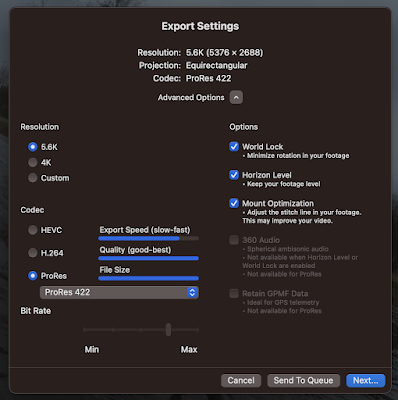
Sharing 360° video?
So, you've got a 360 degree video file from your GoPro. What to do with it? Well, share it on YouTube. YouTube supports uploading and pl...
-
 So, you've got a 360 degree video file from your GoPro. What to do with it? Well, share it on YouTube. YouTube supports uploading and pl...
 -
(CTAN, a meta-level resource for all things TeX www.ctan.org/ ) Step 1: MacTeX packages for Mac. Install MacTeX, after which do the foll...
-
What if "analytics-as-a-service" was an operating model you could plug into your firm's infrastructure? See practicalanalyt...